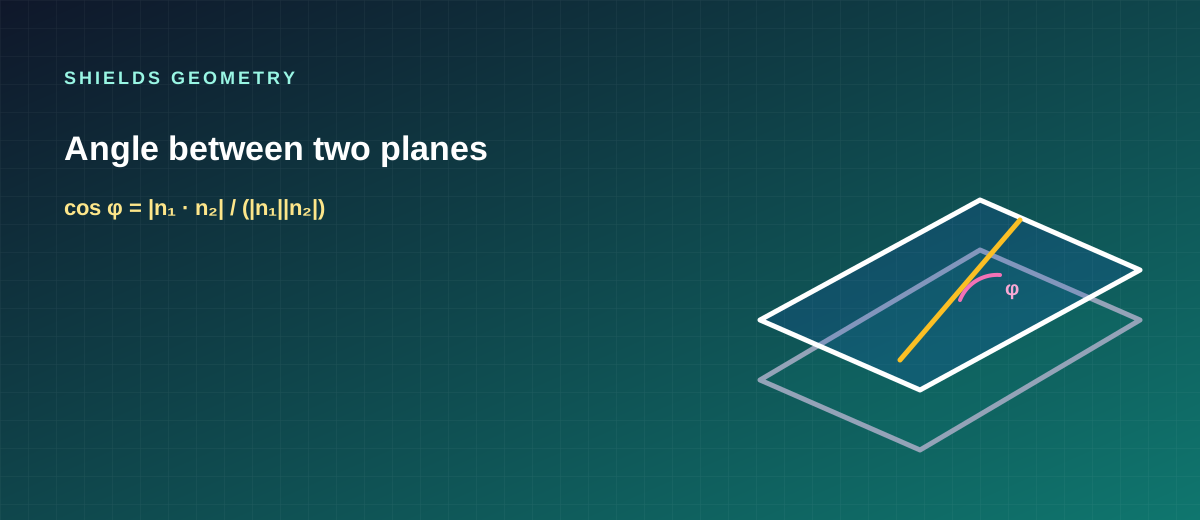
The angle between planes equals the angle between their normals — or between lines of greatest slope on a clear diagram.
Key formulas
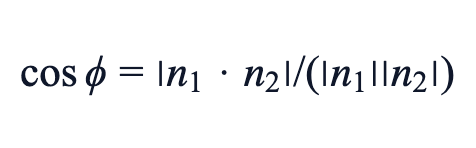
Normals make it algebraic
If each plane has a normal vector, the angle between those normals is the angle between the planes. Take the acute angle unless the question specifies otherwise.
Diagram route
In a solid, drop perpendiculars to the line of intersection and build a right triangle whose face angle matches the dihedral angle.
Worked normal method
n₁=(1,0,0), n₂=(1,1,0). cos φ = 1/√2 so φ = 45°.
Worked example
Worked example
Problem. Two planes have normals n₁ = (1, 0, 0) and n₂ = (1, 1, 0). Find the angle between the planes.
Solution. cos φ = |n₁ · n₂| / (|n₁||n₂|) = |1| / (1 · √2) = 1/√2. Therefore φ = 45°.
Reminder
Parallel planes have parallel normals; the angle is 0°.
Review quiz
Normals (2,0,0) and (2,2,0). Angle between planes is:
Practice questions
- n₁=(2,0,0), n₂=(0,2,0). Find the angle.
- Describe a diagram method when normals are not given.
Study notes
Acute or obtuse?
Exam answers usually want the acute angle between planes.
More in Spatial Geometry
- Pyramid volume: identify the base and perpendicular height
- Distance from a point to a plane using volume
- Finding the angle between a line and a plane
- Writing the equation of a plane in 3D
- Cylinder volume and curved surface area
- Cone volume when slant height is given
- Prism volume from a cross-section
- Sphere volume without the fear of π