Finding the angle between a line and a plane
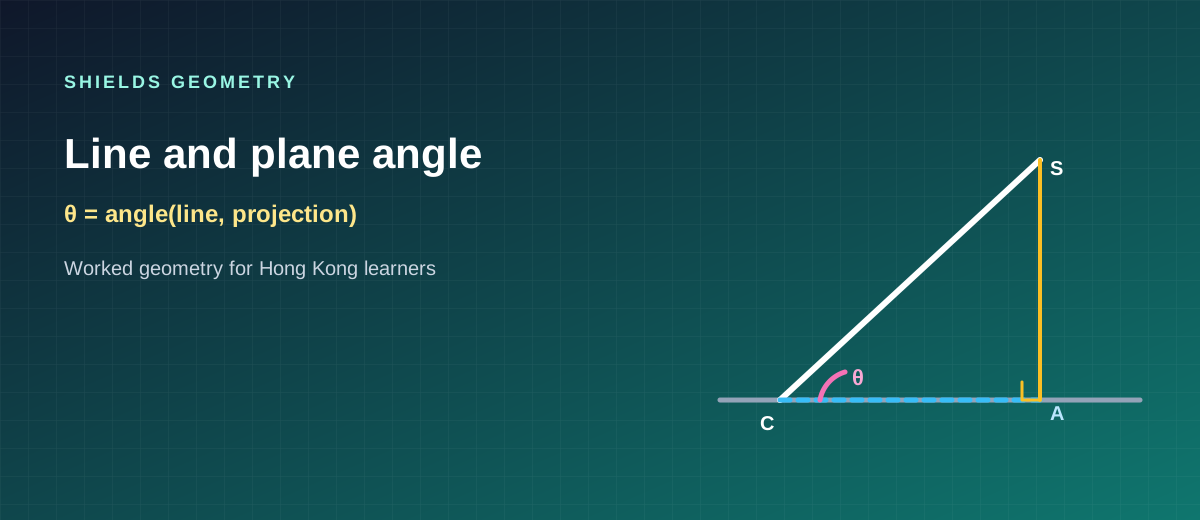
Project the line onto the plane, then use a right triangle to find the angle.
Key formulas


Definition first
The angle between a line and a plane is the angle between the line and its orthogonal projection on the plane. Do not pick a random visible angle in the solid until you have named the projection.
Worked example
Point S is 4 cm above base point A. Point C lies on the base and AC = 3 cm. The line SC makes angle θ with the base plane. In right triangle SAC, SA = 4, AC = 3, so tan θ = 4/3 and θ = arctan(4/3) ≈ 53.1°.
Boundary checks
If the line is perpendicular to the plane, θ = 90°. If the line lies in the plane, θ = 0°. These extremes catch sketching errors quickly.
Worked example
Worked example
Problem. A line rises 5 cm vertically while its projection on the base plane runs 12 cm. Find the angle θ between the line and the plane.
Solution. tan θ = opposite/adjacent = 5/12. So θ = tan⁻¹(5/12) ≈ 22.6°. The angle between the line and the plane is about 22.6°.
Numbers to remember
Rise 4, run 3 → tan θ = 4/3. Rise 5, run 12 → tan θ = 5/12.
Review quiz
A line rises 7 units while its projection on the plane runs 24 units. Which is true?
Practice questions
- If SA = 5 cm and AC = 12 cm, find tan θ for the angle between SC and the base.
- Sketch SC, its projection AC, and mark angle SCA.
Study notes
Is θ the angle at C or at S?
It is the angle between SC and AC, usually marked at C in triangle SAC.
Do I need sine or tangent?
Use whichever ratio matches the sides you know.
More in Spatial Geometry
- Pyramid volume: identify the base and perpendicular height
- Distance from a point to a plane using volume
- Writing the equation of a plane in 3D
- Cylinder volume and curved surface area
- Cone volume when slant height is given
- Prism volume from a cross-section
- Sphere volume without the fear of π
- Space diagonal of a cube