Parallel and perpendicular gradients
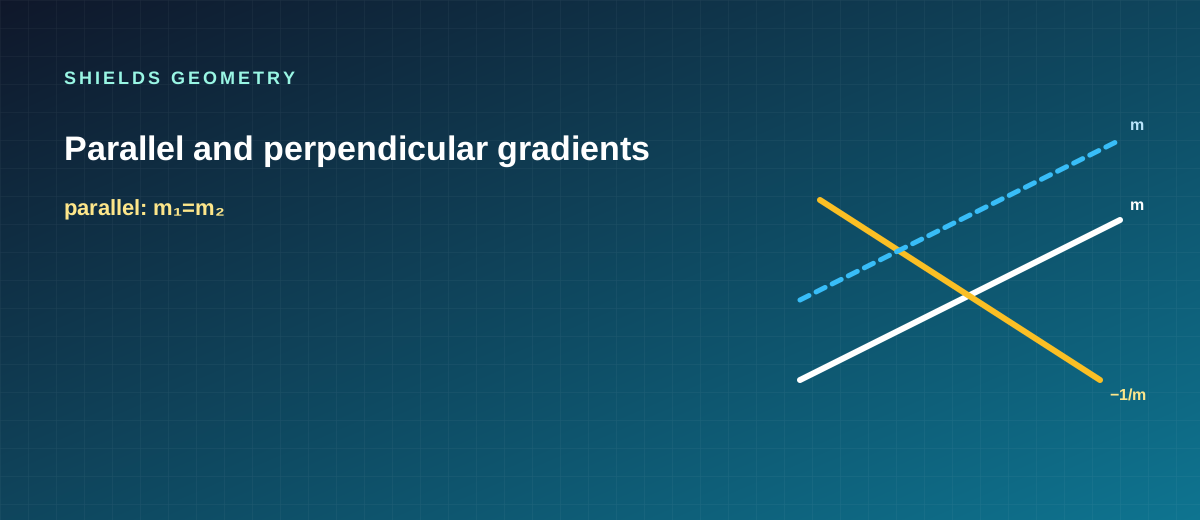
Parallel lines share m; perpendicular lines satisfy m₁m₂ = −1.
Key formulas
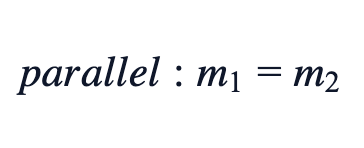
Parallel
Line with m=2 through (0,1) is y=2x+1. Any parallel line is y=2x+c.
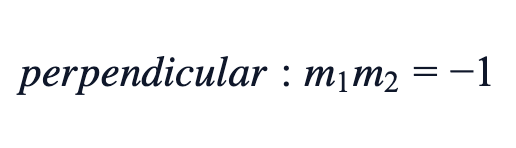
Perpendicular
If m=2, a perpendicular gradient is −1/2. Through (4,0): y−0=−½(x−4).
Horizontal and vertical
Horizontal m=0 is perpendicular to vertical lines (undefined m). Do not try to multiply by −1 blindly.
Worked example
Worked example
Problem. A line has equation y = 2x + 1. Find the equation of the line perpendicular to it through (4, 0).
Solution. Perpendicular gradient = −1/2. Through (4,0): y − 0 = (−1/2)(x − 4) → y = −x/2 + 2, or x + 2y − 4 = 0.
Product −1
3 and −1/3; 4/5 and −5/4.
Review quiz
Line perpendicular to y=−4x+3 has gradient:
Practice questions
- Find a line perpendicular to y=−3x+1 through the origin.
- Are y=2x and y=2x−7 parallel?
Study notes
Negative reciprocals?
Yes — flip the fraction and change the sign.