Isosceles triangles and equal base angles
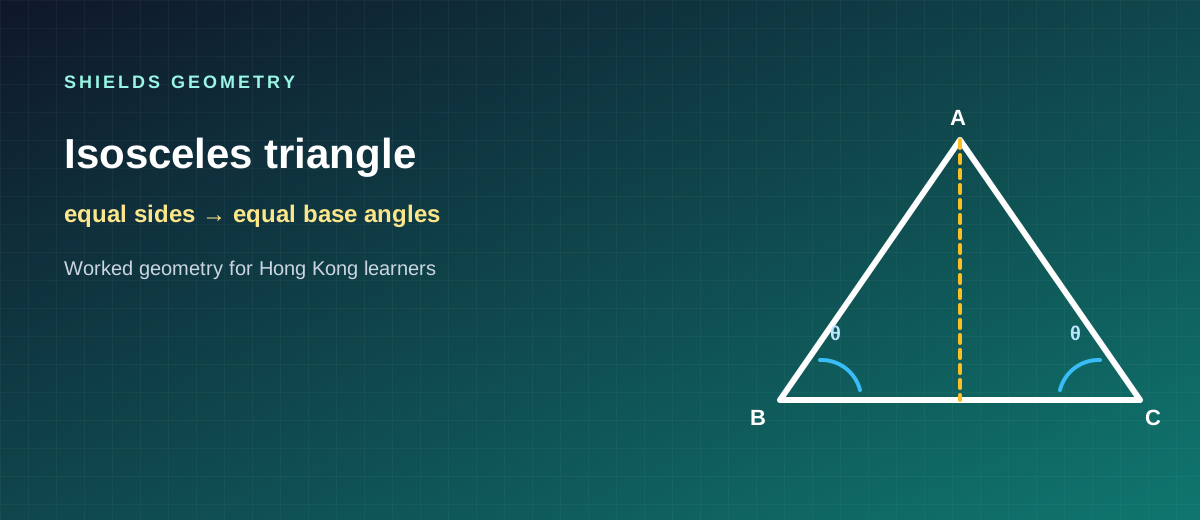
Equal sides give equal base angles; use that to finish missing-angle problems quickly.
Key formulas
Key property
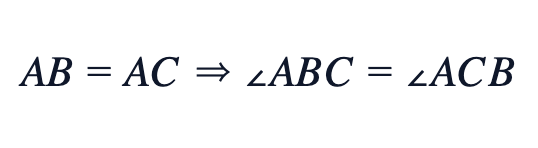
In an isosceles triangle, the angles opposite the equal sides are equal. Mark the equal sides first so the equal angles are obvious.
Worked example
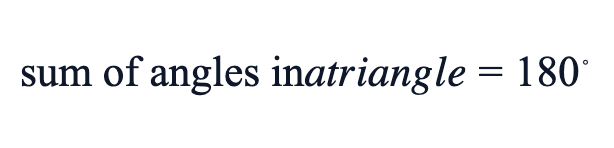
In △ABC, AB = AC and ∠BAC = 40°. The base angles are equal, so each is (180° − 40°) / 2 = 70°. Therefore ∠ABC = ∠ACB = 70°.
Exterior angle follow-up
If side BC is extended to D, the exterior angle ACD equals ∠ABC = 70° by the exterior angle theorem (equal to the remote interior angle when the diagram fits), or compute 180° − 70° = 110° if ACD is adjacent on a straight line. Read which angle is asked.
Worked example
Worked example
Problem. In isosceles △ABC with AB = AC, the vertex angle ∠A = 40°. Find the base angles.
Solution. Base angles are equal: ∠B = ∠C. Angle sum: 40° + 2∠B = 180° → 2∠B = 140° → ∠B = ∠C = 70°.
Vertex angle unknown
Base angles each 55° → vertex angle = 180° − 110° = 70°.
Review quiz
Isosceles with vertex angle 50°. Each base angle is:
Practice questions
- AB = AC and ∠ABC = 65°. Find ∠BAC.
- An isosceles triangle has vertex angle 20°. Find each base angle.
Study notes
Which angles are the base angles?
The two angles adjacent to the base, opposite the equal sides.
Can an isosceles triangle be right-angled?
Yes. Base angles 45° and 45° with vertex 90° is the familiar isosceles right triangle.
More in Plane Geometry
- Circle tangents: the radius is perpendicular
- Right-triangle lengths: Pythagoras and altitude
- Similar triangles: matching sides in proportion
- Chord theorem: perpendicular from the centre
- Alternate segment theorem with a short proof
- Converse of Pythagoras: proving a right angle
- Heron’s formula when height is hidden
- Exterior angle of a triangle