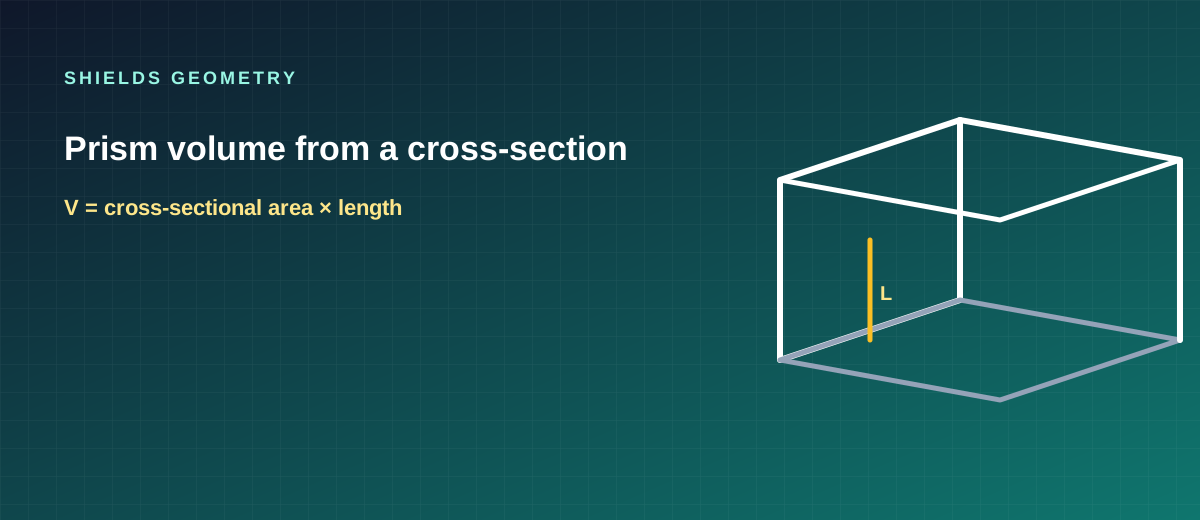
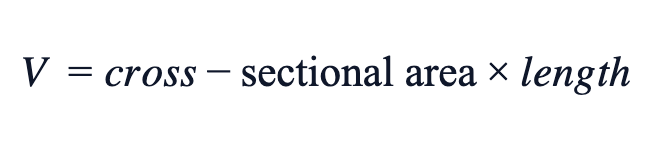
Once the cross-section area is known, prism volume is just that area times the length.
Key formulas
See the solid as a stack
A prism has the same cross-section all the way along. Find the area of that face first. Then multiply by how far the solid extends. Triangular prisms, rectangular boxes and hexagonal columns all follow the same idea.
Numbers
A triangular cross-section has base 8 cm and height 5 cm, so its area is 20 cm². If the prism is 12 cm long, V = 20 × 12 = 240 cm³.
Watch the orientation
Sometimes the “length” is drawn vertically. It does not matter: use whichever direction is perpendicular to the chosen cross-section.
Worked example
Worked example
Problem. A triangular prism has cross-section base 6 cm, height 4 cm, and length 15 cm. Find its volume.
Solution. Cross-section area = (1/2) × 6 × 4 = 12 cm². Volume = 12 × 15 = 180 cm³.
Quick check
Cross-section 15 cm², length 9 cm → V = 135 cm³.
Review quiz
Cross-section 20 cm², length 9 cm. Prism volume is:
Practice questions
- A rectangular cross-section is 4 cm by 7 cm and the prism is 10 cm long. Find the volume.
- Why must the length be measured perpendicular to the cross-section?
Study notes
Is a cylinder a prism?
It is a circular prism in the same spirit: V = πr² × height.
More in Spatial Geometry
- Pyramid volume: identify the base and perpendicular height
- Distance from a point to a plane using volume
- Finding the angle between a line and a plane
- Writing the equation of a plane in 3D
- Cylinder volume and curved surface area
- Cone volume when slant height is given
- Sphere volume without the fear of π
- Space diagonal of a cube