Turn a two-leg bearing journey into north/east components, then find the resultant.
Key formulas

Reading a bearing
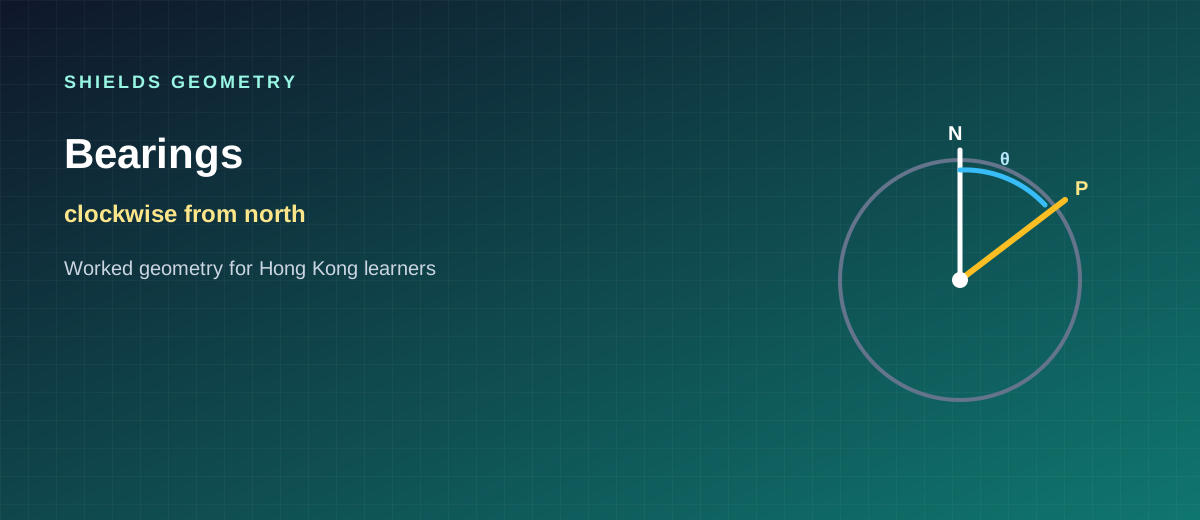
A bearing is an angle measured clockwise from north, usually written with three figures such as 090° or 225°. Sketch north arrows at each turning point before resolving components.
Worked example
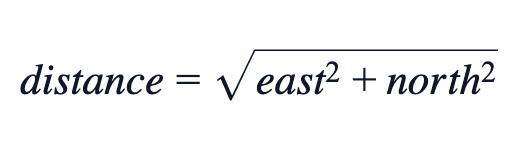
A ship sails 8 km due east, then 6 km due north. The straight-line distance from the start is √(8² + 6²) = √(64 + 36) = 10 km. The bearing from the start to the finish satisfies tan θ = east/north = 8/6 = 4/3, so θ = arctan(4/3) ≈ 53.1° east of north, which is bearing 053° approximately.
Presentation
Draw a right triangle with east and north legs, mark the resultant as the hypotenuse, and state both the distance and the bearing if both are asked.
Worked example
Worked example
Problem. A ship sails 8 km due east, then 6 km due north. Find the straight-line distance back to the start and the bearing of the return course.
Solution. Distance = √(8² + 6²) = 10 km. From the end point back to start is southwest-ish: tan⁻¹(8/6) west of south → bearing = 180° + tan⁻¹(4/3) ≈ 233°. More precisely: direction is 180° + θ where θ = tan⁻¹(8/6) ≈ 53.1°, so bearing ≈ 233.1°.
3-4-5 reminder
Legs 6 and 8 give hypotenuse 10, the familiar 3-4-5 triangle scaled by 2.
Review quiz
Walk 5 km south then 12 km east. Straight distance back to start is:
Practice questions
- A walker goes 5 km south and 12 km east. Find the straight-line distance from the start.
- In the previous question, is the bearing from start to finish closer to 090° or 180°?
Study notes
Is bearing the same as compass direction words?
Bearings are numerical. “Due east” is bearing 090°.
Do I need a calculator for arctan?
For exact trig ratios you may leave θ = arctan(4/3); many papers accept a rounded degree.