A timed geometry plan for HKDSE-style papers
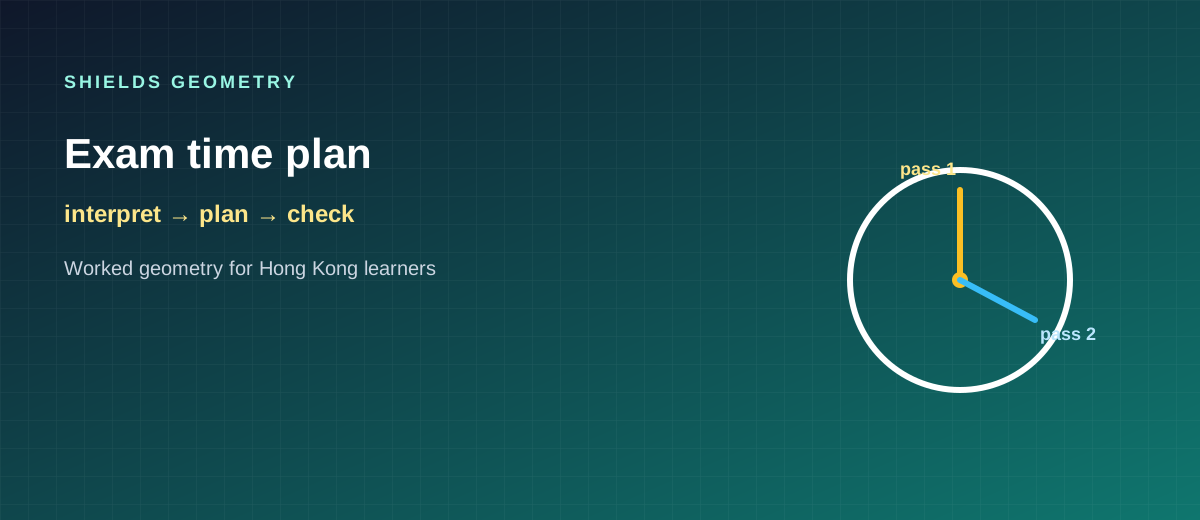
A two-pass timing method that protects easy marks before you attack harder constructions.
Key formulas
First pass (about 40% of the time)
Answer direct formula questions and diagrams you can interpret immediately. Mark any question that needs a long construction and move on. Collecting secure marks early reduces panic later.
Second pass
Return to angle, distance and coordinate questions. Sketch, label given lengths, and write the relationship before calculating. If a question stalls for more than a few minutes, leave a clear last correct line and continue.
After the paper: a 60-minute review
Spend 10 minutes listing mistakes by type (diagram, formula, algebra, arithmetic, timing), 25 minutes reworking medium questions, 15 minutes updating your formula sheet, and 10 minutes retrying one difficult question without notes.
Worked example
Worked example
Problem. You have 40 minutes for 8 mixed geometry questions. Two look like long constructions. How should you split the time?
Solution. Pass 1 (about 20 min): secure the 6 direct questions. Pass 2 (about 15 min): attempt the two constructions. Final 5 min: unit/check pass. Do not spend the first 15 minutes on one hard diagram.
Sample pacing for 12 mixed questions
Questions 1–5 in 20 minutes, 6–9 in 25 minutes, 10–12 in 20 minutes, 5 minutes for checking units and unanswered parts.
Review quiz
With 5 minutes left and two unfinished hard constructions, you should:
Practice questions
- Complete 12 mixed geometry questions and label each Easy / Medium / Hard.
- Keep an error log for one week with the exact wrong decision written out.
Study notes
Should I start with the hardest question?
Usually no. Secure marks first, then invest time in constructions.
What belongs in an error log?
The diagram issue, the formula used, the failing line, and the check that would have caught it.