Cylinder volume and curved surface area
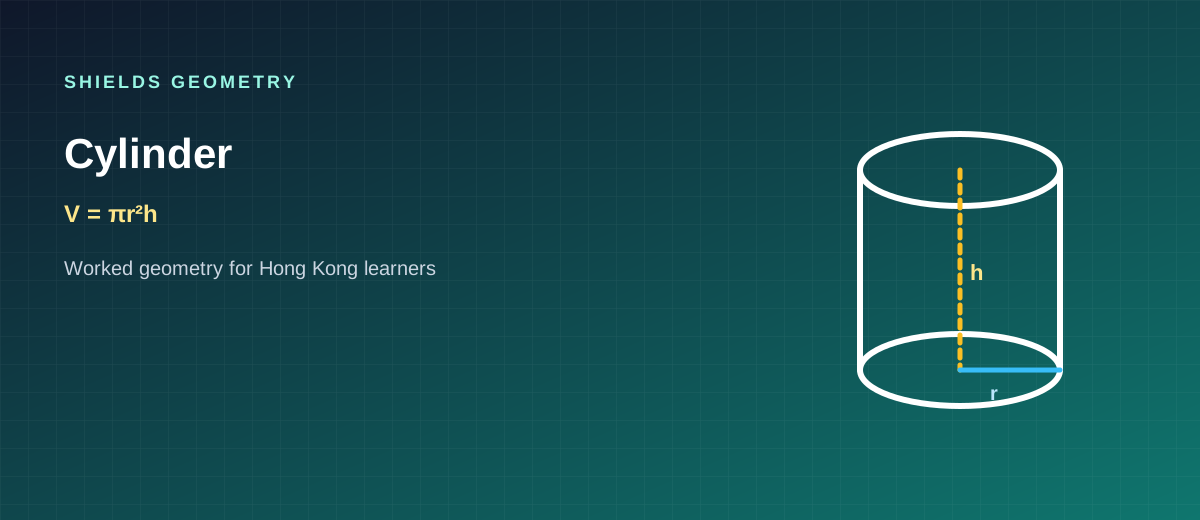
Separate volume from surface area so you do not mix πr²h with 2πrh.
Key formulas
Two different questions
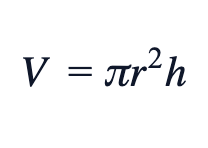
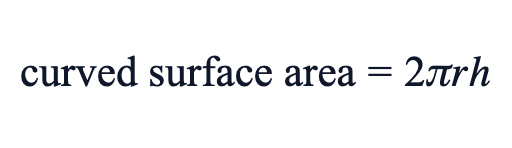
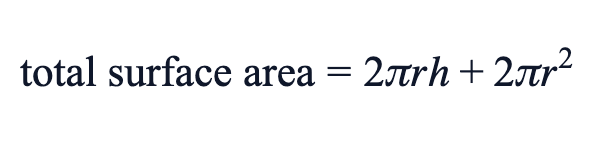
Volume fills the interior. Curved surface area wraps the side. Total surface area adds the two circular ends. Read the wording carefully before choosing a formula.
Worked example
A closed cylinder has radius 4 cm and height 10 cm. Volume = π × 16 × 10 = 160π cm³. Curved surface area = 2π × 4 × 10 = 80π cm². Total surface area = 80π + 2π × 16 = 80π + 32π = 112π cm².
Open cylinder warning
If the cylinder is open at one end, total surface area becomes 2πrh + πr². Always ask how many circular faces are included.
Worked example
Worked example
Problem. A cylinder has radius 4 cm and height 10 cm. Find its volume and curved surface area in terms of π.
Solution. V = πr²h = π × 16 × 10 = 160π cm³. Curved surface = 2πrh = 2π × 4 × 10 = 80π cm².
Quick numbers
r = 3, h = 8 → V = 72π. Curved area = 48π.
Review quiz
Cylinder r=3, h=7. Volume in terms of π is:
Practice questions
- Find the volume and curved surface area of a cylinder with r = 5 cm and h = 12 cm.
- A cylinder is open at the top. Find its total surface area when r = 6 and h = 9.
Study notes
Why keep answers in terms of π?
The question often asks for an exact value, and it prevents calculator rounding.
How do I remember 2πrh?
Unroll the side into a rectangle of width 2πr and height h.
More in Spatial Geometry
- Pyramid volume: identify the base and perpendicular height
- Distance from a point to a plane using volume
- Finding the angle between a line and a plane
- Writing the equation of a plane in 3D
- Cone volume when slant height is given
- Prism volume from a cross-section
- Sphere volume without the fear of π
- Space diagonal of a cube