Parallelogram area from two vectors
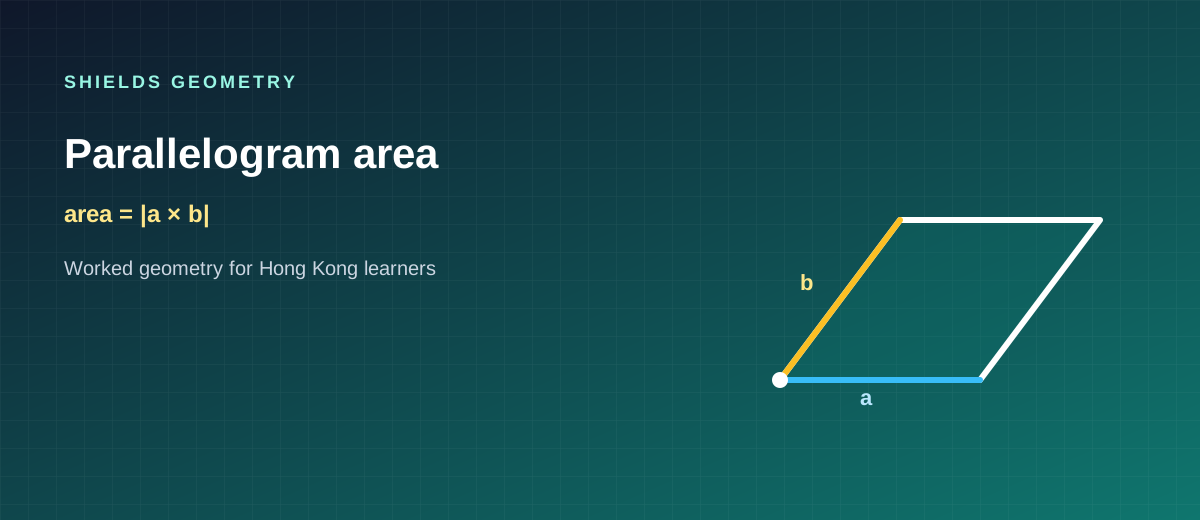
In 2D, the absolute value of the determinant of two side vectors is the parallelogram area.
Key formulas

Idea
If adjacent sides of a parallelogram are given as vectors a and b, the area equals the magnitude of their 2D cross product. No need to find the height separately when coordinates are available.
Worked example
Let a = (3, 1) and b = (1, 4). Area = |3 × 4 − 1 × 1| = |12 − 1| = 11. So the parallelogram has area 11 square units.
Triangle note
A triangle with the same two sides from one vertex has area half of that parallelogram. With the same vectors, triangle area = 11/2 = 5.5.
Worked example
Worked example
Problem. Vectors a = (3, 0) and b = (1, 4) form adjacent sides of a parallelogram. Find its area.
Solution. In 2D, |a × b| = |3·4 − 0·1| = 12. The area of the parallelogram is 12 square units.
Collinear warning
If a = (2, 4) and b = (1, 2), area = |4 − 4| = 0. The vectors are parallel, so they do not form a proper parallelogram.
Review quiz
a=(5,2), b=(−1,6). Parallelogram area is:
Practice questions
- Find the parallelogram area for a = (5, 2) and b = (−1, 3).
- Find the triangle area with sides (4, 0) and (2, 3) from the same vertex.
Study notes
Does order matter?
Swapping a and b changes the sign inside the absolute value, but the area is unchanged.
What about 3D?
Use the magnitude of the full cross product a × b.