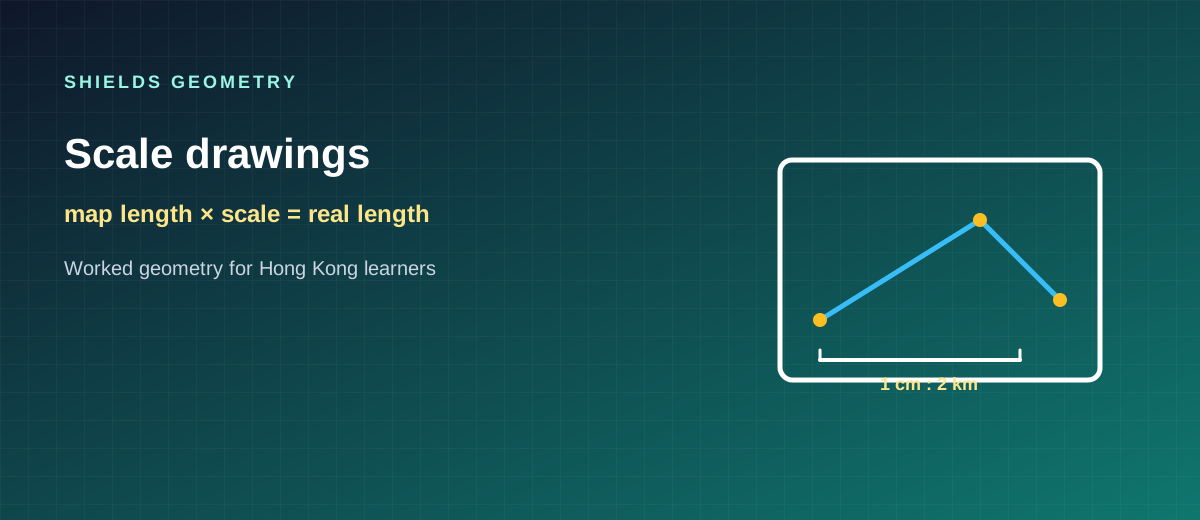
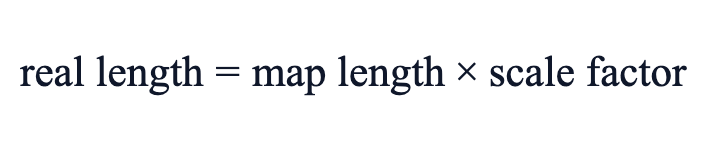
Convert a map length to a real length using a ratio scale such as 1:25000.
Key formulas
Reading 1:25000
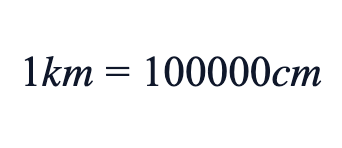
The scale 1:25000 means 1 cm on the map represents 25000 cm in reality, which is 250 m or 0.25 km. Keep units consistent before multiplying.
Worked example
On a 1:25000 map, two towns are 6.4 cm apart. Real distance = 6.4 × 25000 = 160000 cm = 1600 m = 1.6 km.
Reverse problem
A real footpath is 2 km long. In centimetres that is 200000 cm. Map length = 200000 / 25000 = 8 cm.
Worked example
Worked example
Problem. A map has scale 1 : 25000. Two towns are 4.8 cm apart on the map. Find the real distance in km.
Solution. Real length = 4.8 × 25000 = 120000 cm = 1200 m = 1.2 km. The towns are 1.2 km apart.
Scale 1:50000
5 cm on the map → 5 × 50000 = 250000 cm = 2.5 km.
Review quiz
Scale 1:10000. Map length 3.5 cm. Real distance in metres is:
Practice questions
- Scale 1:10000. Map distance 3.5 cm. Find the real distance in metres.
- Real distance 4.5 km on a 1:25000 map. Find the map length in cm.
Study notes
Should I convert to km or m first?
Pick one unit and stay with it until the final sentence.
Are map scales always centimetres?
Any unit works if both sides of the ratio use the same unit.
More in Applied & Exam
- Geometry formula sheet with quick checks
- A timed geometry plan for HKDSE-style papers
- Bearings and a right-triangle journey
- Command words: find, show, explain, hence
- Annotating the exam diagram in the first minute
- A 30-second unit and scale check
- Map scales and area factors
- Back bearings and reverse journeys