Reflection across the axes and y = x
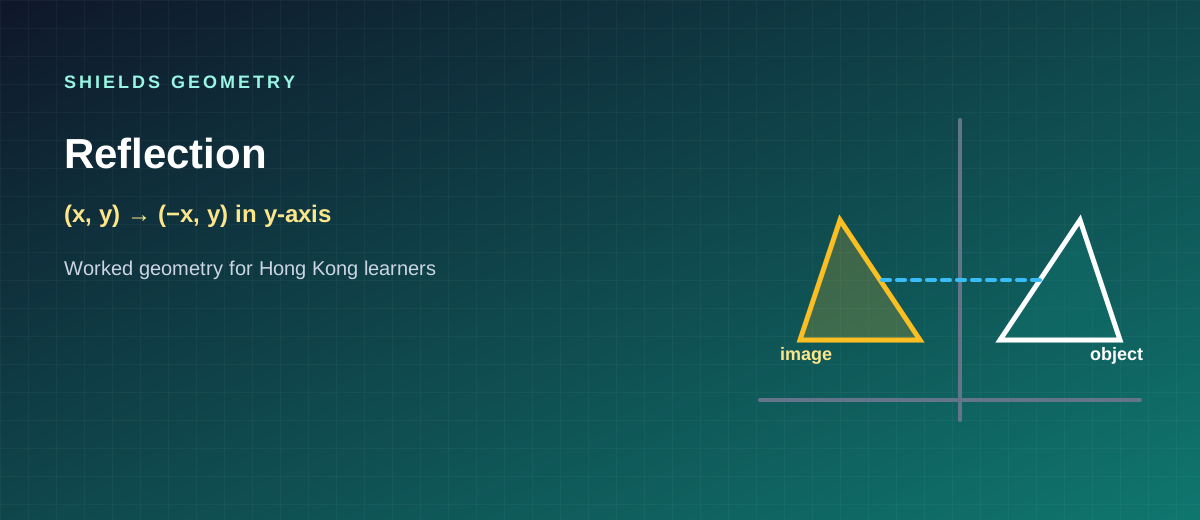
Reflect points with simple coordinate rules, then verify distance to the mirror line.
Key formulas
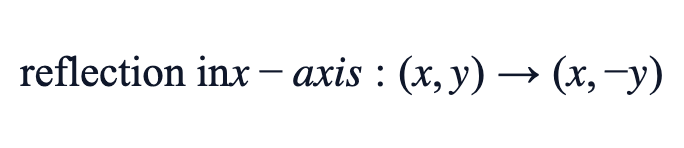
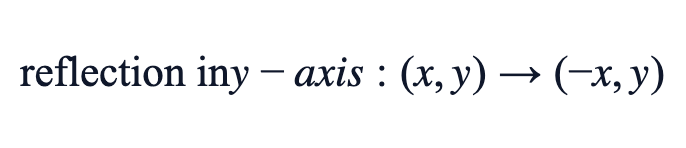
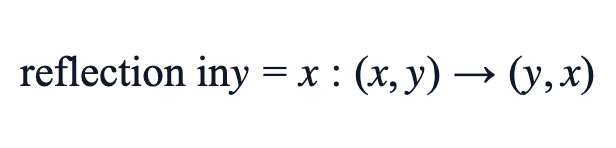
Rules to trust
Reflection is an isometry: lengths and angles stay the same, orientation reverses. On the coordinate plane the standard mirrors give clean formulas you can apply point by point.
Worked example
Point P(3, 5). Reflection in the x-axis is P₁(3, −5). Reflection in the y-axis is P₂(−3, 5). Reflection in the line y = x is P₃(5, 3). Each image is the same distance from the mirror as P is.
Segment check
Segment from A(1, 2) to B(4, 6) reflected in the x-axis becomes A'(1, −2) to B'(4, −6). Length before: √((4 − 1)² + (6 − 2)²) = 5. Length after: √(3² + (−4)²) = 5.
Worked example
Worked example
Problem. Reflect the point (3, −2) in the y-axis and then in the line y = x.
Solution. Reflection in y-axis: (3, −2) → (−3, −2). Reflection in y = x swaps coordinates: (−3, −2) → (−2, −3). Final image: (−2, −3).
Triangle image
Reflecting (0, 0), (2, 0), (0, 3) in y = x gives (0, 0), (0, 2), (3, 0).
Review quiz
Reflect (4,5) in the x-axis. Result is:
Practice questions
- Reflect (6, −2) in the y-axis and in y = x.
- Show that the midpoint of a point and its x-axis image lies on the x-axis.
Study notes
Does reflection change size?
No. It is a congruence transformation.
What is the mirror of a point on the line?
The point itself: it is a fixed point of the reflection.