Distance from a point to a plane using volume
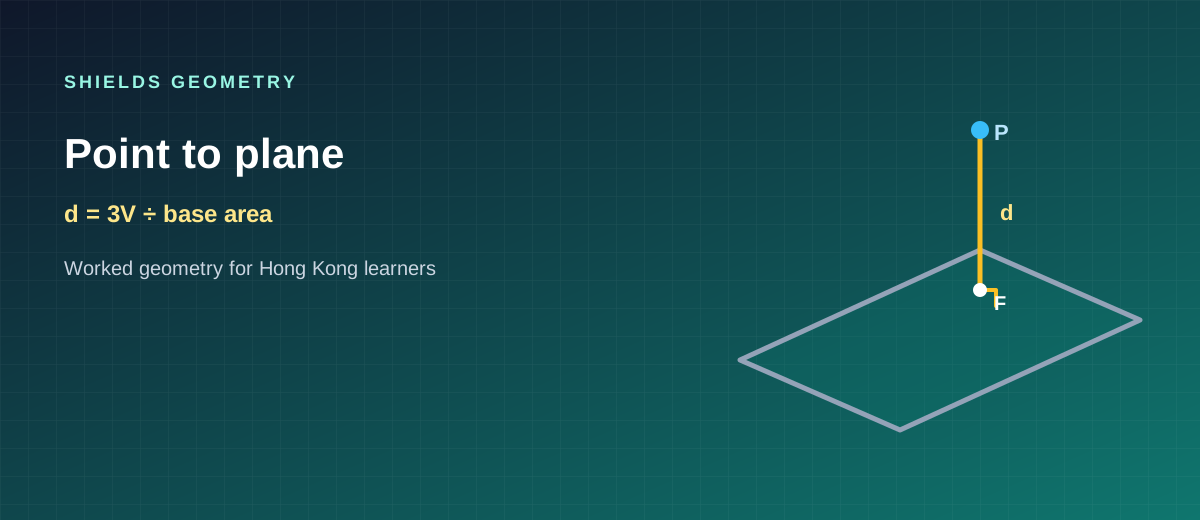
Use equal volume expressions to find the perpendicular distance from a point to a plane.
Key formulas
Why volume helps
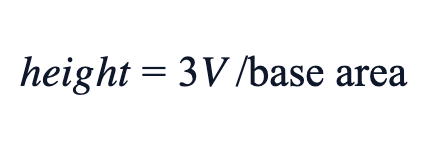
If the same solid can be viewed with two different bases, its volume is unchanged. One expression may use a convenient height you already know; the other isolates the unknown perpendicular distance to a face.
Worked example
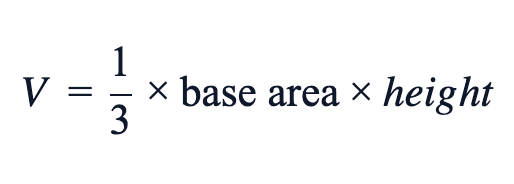
A triangular pyramid has volume 96 cm³. One face has area 24 cm² and the opposite vertex is at unknown perpendicular distance d from that face. Using V = (1/3) × base area × height gives 96 = (1/3) × 24 × d, so 96 = 8d and d = 12 cm.
Presentation
Write: volume with known data, volume with unknown distance, then equate. Finish with “Therefore the required distance is 12 cm.” Distances are non-negative.
Worked example
Worked example
Problem. A triangular pyramid has volume 120 cm³. One face has area 30 cm². Find the perpendicular distance from the opposite vertex to that face.
Solution. Use V = (1/3) × base area × height: 120 = (1/3) × 30 × d → 120 = 10d → d = 12 cm. The required distance is 12 cm.
Compact solution
96 = (1/3) × 24 × d → 288 = 24d → d = 12 cm.
Review quiz
A pyramid has volume 45 cm³ and one face of area 18 cm². The perpendicular distance from the opposite vertex to that face is:
Practice questions
- If V = 45 cm³ and the face area is 18 cm², find the perpendicular distance to that face.
- Rearrange V = (1/3)Ah to make h the subject, then substitute A = 30 and V = 70.
Study notes
When is this better than construction?
When the volume and a face area are easy, but drawing the perpendicular would be messy.
Can d be negative?
No. Distance is the positive length of the perpendicular segment.
More in Spatial Geometry
- Pyramid volume: identify the base and perpendicular height
- Finding the angle between a line and a plane
- Writing the equation of a plane in 3D
- Cylinder volume and curved surface area
- Cone volume when slant height is given
- Prism volume from a cross-section
- Sphere volume without the fear of π
- Space diagonal of a cube