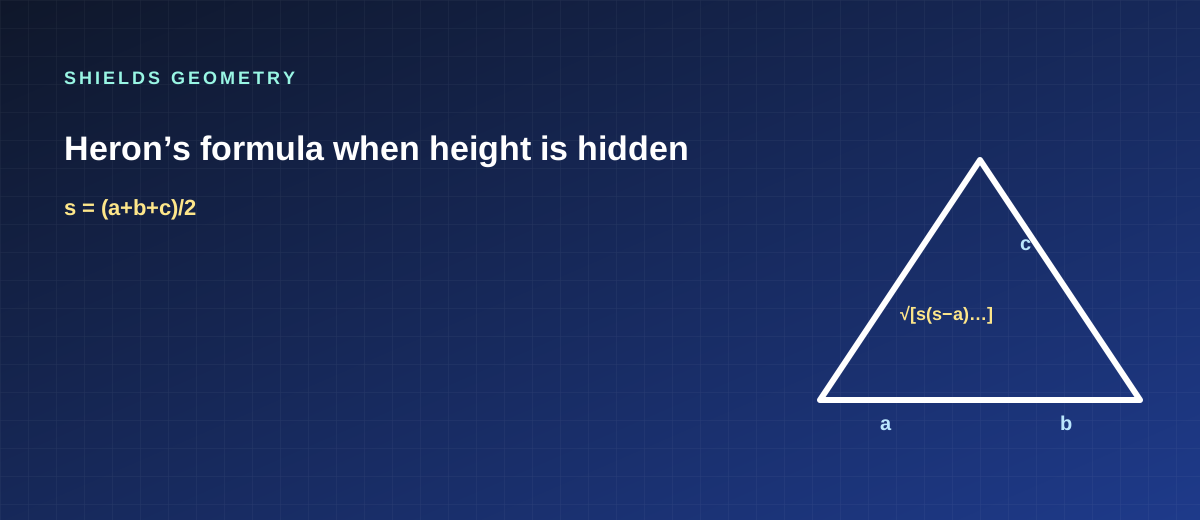
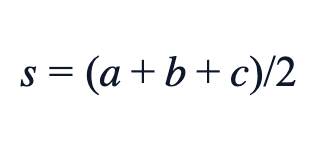
With three sides known, s = (a+b+c)/2 and area = √[s(s−a)(s−b)(s−c)].
Key formulas
![area = √[s(s−a)(s−b)(s−c)]](/formulas/f8717a541798e385.png "area = √[s(s−a)(s−b)(s−c)]")
When to use it
No perpendicular height is marked and no angle is given — only three sides. Heron avoids dropping an awkward altitude.
Example
Sides 5, 5, 6. s=8. Area = √[8(3)(3)(2)] = √144 = 12.
Triangle inequality
If s−a is negative, the lengths do not form a triangle. Stop there.
Worked example
Worked example
Problem. Find the area of a triangle with sides 5, 5 and 6.
Solution. s = (5+5+6)/2 = 8. Area = √[8(8−5)(8−5)(8−6)] = √[8×3×3×2] = √144 = 12.
Isosceles shortcut
For 5,5,6 you could also split the base; Heron confirms the same 12.
Review quiz
Sides 7, 8, 9. Semi-perimeter s is:
Practice questions
- Sides 7, 8, 9. Find the area.
- Why must each (s−side) be positive?
Study notes
Is Heron allowed in HKDSE?
Yes when three sides are known; show the substitution clearly.
More in Plane Geometry
- Circle tangents: the radius is perpendicular
- Right-triangle lengths: Pythagoras and altitude
- Similar triangles: matching sides in proportion
- Chord theorem: perpendicular from the centre
- Isosceles triangles and equal base angles
- Alternate segment theorem with a short proof
- Converse of Pythagoras: proving a right angle
- Exterior angle of a triangle