Section formula with position vectors
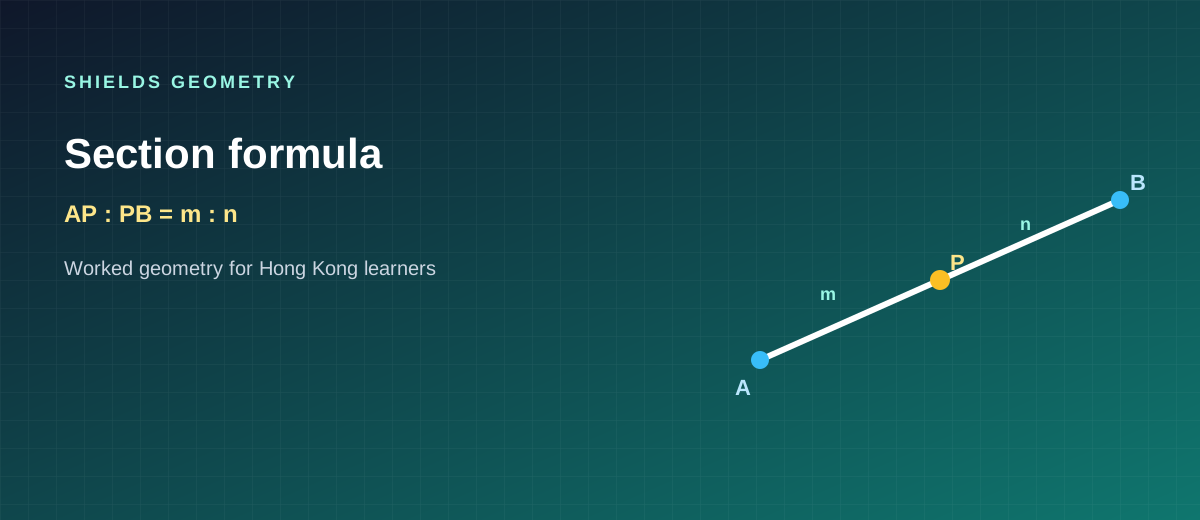
Find the point that divides a segment in a given ratio using position vectors.
Key formulas

Meaning of the ratio
If P divides AB in m:n, then AP:PB = m:n. The weights reverse in the formula: the coefficient of A is n and the coefficient of B is m.
Worked example
A has position vector (2, 1) and B has (8, 7). P divides AB in 1:2. Then OP = (2·(2, 1) + 1·(8, 7)) / (1 + 2) = ((4, 2) + (8, 7)) / 3 = (12, 9)/3 = (4, 3). So P is (4, 3).
Midpoint special case
For a midpoint, m:n = 1:1, so OP = (OA + OB)/2. Midpoint of (2, 1) and (8, 7) is (5, 4).
Worked example
Worked example
Problem. A has position vector (1, 2) and B has (7, 8). Point P divides AB in the ratio 1 : 2. Find the position vector of P.
Solution. p = (n a + m b)/(m + n) with m:n = 1:2 → p = (2(1,2) + 1(7,8))/3 = ((2,4)+(7,8))/3 = (9,12)/3 = (3,4). So P is (3, 4).
External division note
External division uses a minus sign in the related formula. For this lesson, stay with internal division unless the question says “externally”.
Review quiz
P divides A(0,0) to B(15,20) in ratio 3:2. P is:
Practice questions
- P divides the join of (0, 0) and (9, 6) in 2:1. Find the coordinates of P.
- Find the midpoint of (3, −2) and (−5, 8).
Study notes
Why is A multiplied by n?
P is closer to the endpoint with the larger weight. If m:n = 1:2, P is closer to A, so A gets the larger coefficient 2.
Can I use column vectors?
Yes. The same arithmetic works component by component.