Cone volume when slant height is given
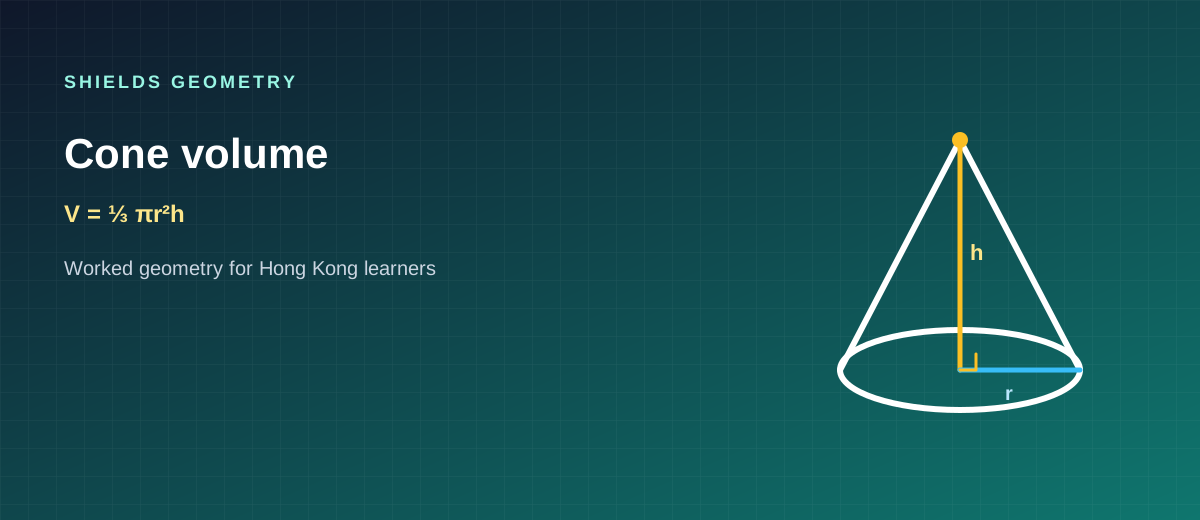
Recover the perpendicular height from radius and slant height before using (1/3)πr²h.
Key formulas
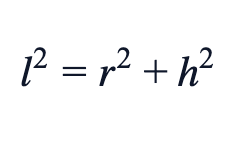
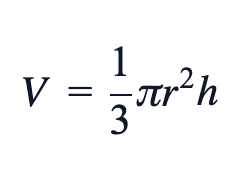
Do not substitute slant height for h
The volume formula needs the perpendicular height. If the question gives slant height l, first form a right triangle with r and h, then find h.
Worked example
A cone has radius 5 cm and slant height 13 cm. Then h² = 13² − 5² = 169 − 25 = 144, so h = 12 cm. Volume = (1/3)π × 25 × 12 = 100π cm³.
Reasonableness check
Because 5-12-13 is a Pythagorean triple, the arithmetic is tidy. If h came out larger than l, the subtraction was reversed.
Worked example
Worked example
Problem. A cone has radius 5 cm and slant height 13 cm. Find its volume in terms of π.
Solution. h = √(ℓ² − r²) = √(169 − 25) = √144 = 12 cm. V = (1/3)πr²h = (1/3)π × 25 × 12 = 100π cm³.
Another triple
r = 8, l = 17 → h = 15, since 8² + 15² = 64 + 225 = 289 = 17².
Review quiz
Cone r=6, slant height 10. Volume is:
Practice questions
- Radius 9 cm, slant height 15 cm. Find the height and the volume in terms of π.
- Explain why slant height cannot be inserted directly into V = (1/3)πr²h.
Study notes
Is slant height on the curved surface?
Yes. It is the distance from the apex to a point on the base circumference along the side.
What if only volume and radius are given?
Solve V = (1/3)πr²h for h.
More in Spatial Geometry
- Pyramid volume: identify the base and perpendicular height
- Distance from a point to a plane using volume
- Finding the angle between a line and a plane
- Writing the equation of a plane in 3D
- Cylinder volume and curved surface area
- Prism volume from a cross-section
- Sphere volume without the fear of π
- Space diagonal of a cube