Right-triangle lengths: Pythagoras and altitude
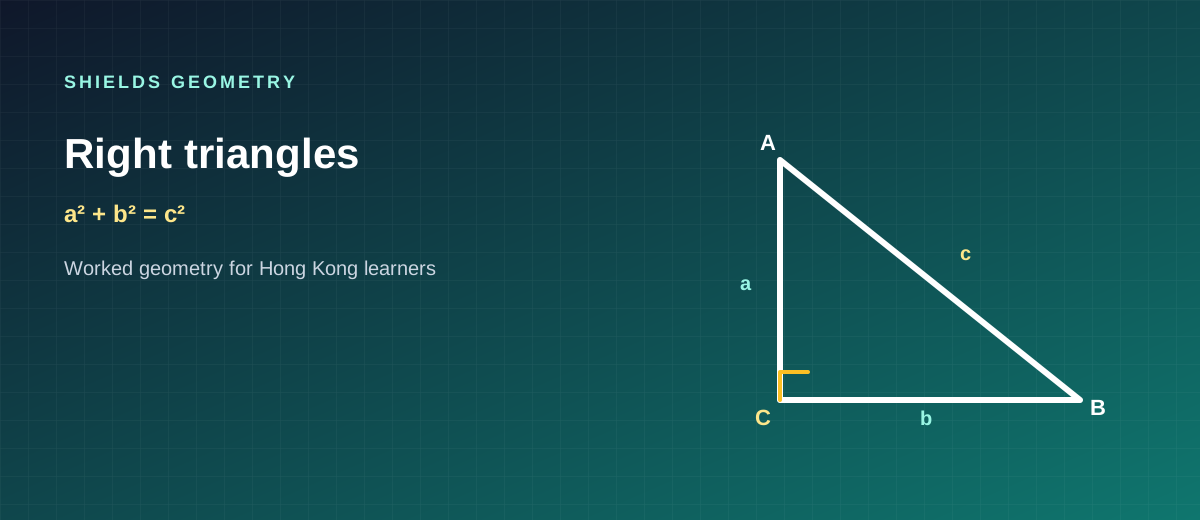
Choose Pythagoras, an altitude relation, or trigonometry according to the given data.
Key formulas
Choosing the tool
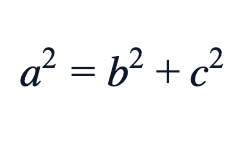
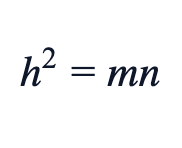
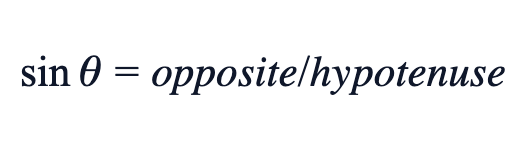
Use Pythagoras when two sides of a right triangle are known. Use h² = mn when an altitude to the hypotenuse splits it into segments m and n. Use sine, cosine or tangent when an acute angle is given.
Worked example A
Legs 3 cm and 4 cm. Hypotenuse c satisfies c² = 9 + 16 = 25, so c = 5 cm. This 3-4-5 triangle is worth memorising because it appears often in exam diagrams.
Worked example B
An altitude to the hypotenuse creates segments 4 cm and 9 cm. Then h² = 4 × 9 = 36, so h = 6 cm. Check: the hypotenuse is 13 cm, and 6 is clearly shorter, as required.
Worked example
Worked example
Problem. In right triangle ABC with ∠C = 90°, AC = 6 and BC = 8. Find AB and the altitude from C to AB.
Solution. AB = √(6² + 8²) = 10. Altitude to hypotenuse: h = (AC × BC)/AB = 48/10 = 4.8. So AB = 10 and the altitude is 4.8.
Trigonometry note
In a right triangle with opposite 5 and hypotenuse 13, sin θ = 5/13.
Review quiz
Right triangle with legs 5 and 12. Hypotenuse is:
Practice questions
- Find the hypotenuse of a right triangle with legs 5 cm and 12 cm.
- If the hypotenuse parts are 3 and 12, find the altitude to the hypotenuse.
Study notes
How do I spot the hypotenuse?
It is the side opposite the right angle and is always the longest side.
What if my answer exceeds the hypotenuse?
Recheck the formula: a leg or altitude cannot be longer than the hypotenuse.
More in Plane Geometry
- Circle tangents: the radius is perpendicular
- Similar triangles: matching sides in proportion
- Chord theorem: perpendicular from the centre
- Isosceles triangles and equal base angles
- Alternate segment theorem with a short proof
- Converse of Pythagoras: proving a right angle
- Heron’s formula when height is hidden
- Exterior angle of a triangle