Chord theorem: perpendicular from the centre
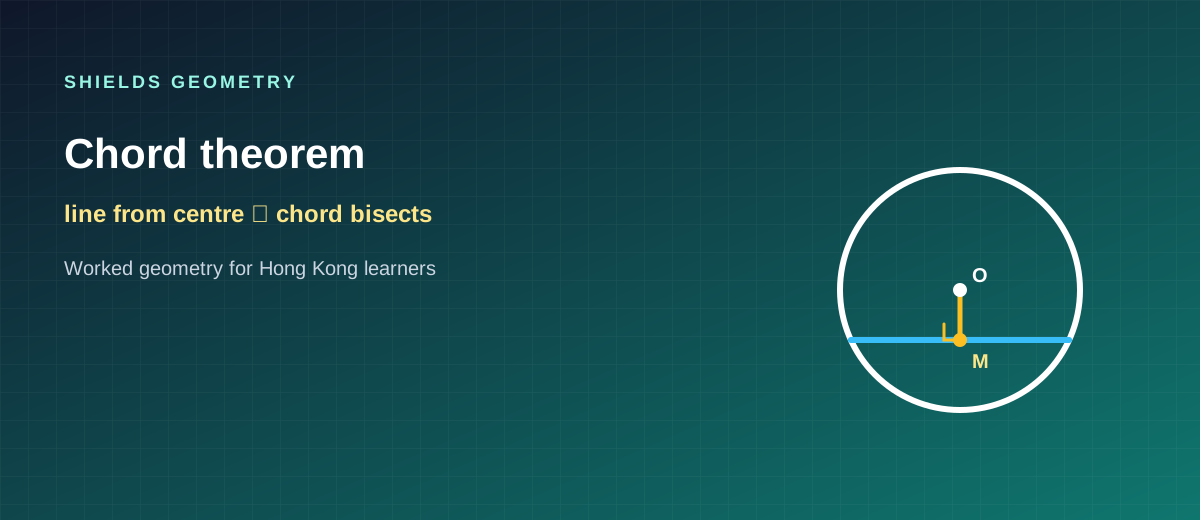
A perpendicular from the centre to a chord bisects the chord.
Key formulas
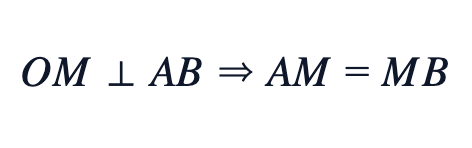
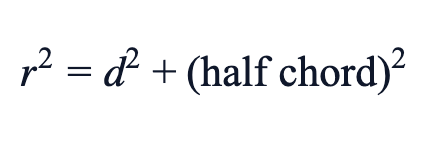
Theorem statement
Let O be the centre and AB a chord. If OM is perpendicular to AB and meets AB at M, then M is the midpoint of AB. The converse is also useful: the line from the centre to the midpoint of a chord is perpendicular to the chord.
Worked example
A circle has radius 13 cm. Chord AB = 10 cm. The perpendicular distance from O to AB is d. Half of AB is 5 cm, so r² = d² + 5² gives 169 = d² + 25 and d² = 144. Therefore d = 12 cm.
Diagram tip
Draw radius OA, drop the perpendicular to M, and mark the right angle. The right triangle OMA then contains all three numbers you need.
Worked example
Worked example
Problem. A circle has centre O and radius 13 cm. Chord AB is 10 cm from O. Find the length of AB.
Solution. The perpendicular from O to AB meets AB at midpoint M. OM = 10, OA = 13, so AM = √(13² − 10²) = √(169 − 100) = √69. Therefore AB = 2√69 cm.
Another set
Radius 10, half-chord 6 → d = 8, because 6-8-10 is a scaled 3-4-5 triangle.
Review quiz
Circle radius 10. Chord is 6 from the centre. Full chord length is:
Practice questions
- Radius 15 cm, chord 18 cm. Find the distance from the centre to the chord.
- Distance from centre to a chord is 5 cm and radius is 13 cm. Find the chord length.
Study notes
Is the perpendicular always inside the circle?
Yes for a chord, M lies between A and B.
What if the chord is a diameter?
Then M is the centre and the distance d is 0.
More in Plane Geometry
- Circle tangents: the radius is perpendicular
- Right-triangle lengths: Pythagoras and altitude
- Similar triangles: matching sides in proportion
- Isosceles triangles and equal base angles
- Alternate segment theorem with a short proof
- Converse of Pythagoras: proving a right angle
- Heron’s formula when height is hidden
- Exterior angle of a triangle