Similar triangles: matching sides in proportion
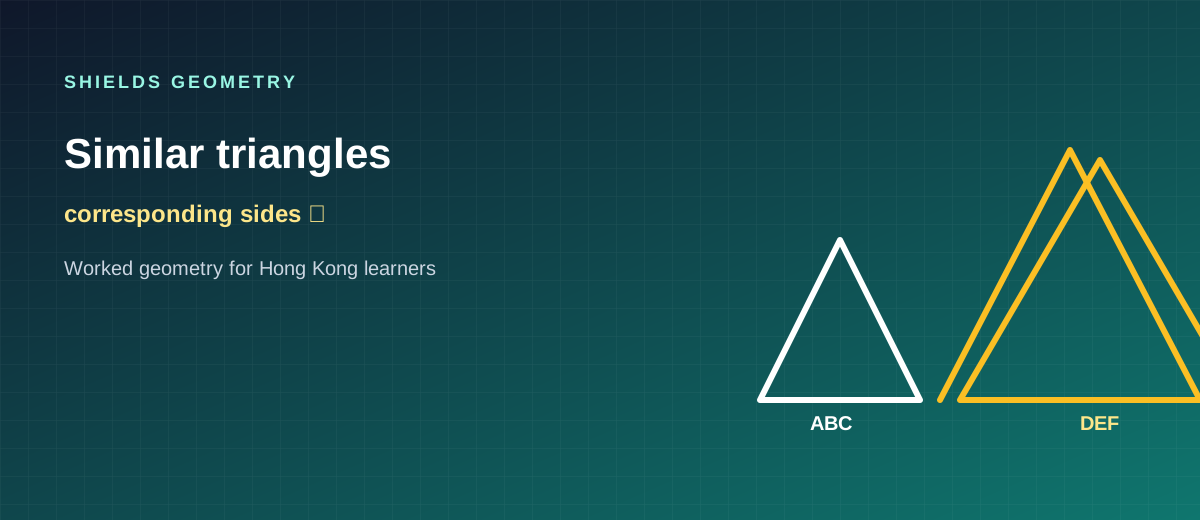
Name corresponding vertices first, then set up a proportion with matching sides.
Key formulas

Correspondence before algebra
If △ABC ∼ △DEF, then A maps to D, B to E and C to F. Matching sides are AB with DE, BC with EF, and AC with DF. A ratio written with unmatched sides is the most common error.
Worked example
△ABC ∼ △DEF with AB = 6, DE = 9 and BC = 10. Find EF. Because AB/DE = BC/EF, we have 6/9 = 10/EF. Cross-multiply: 6 × EF = 90, so EF = 15.
Area follow-up
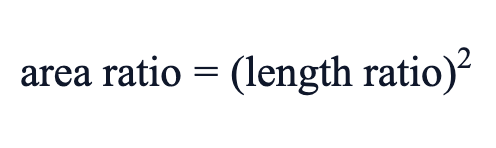
The length ratio is 6:9 = 2:3, so the area ratio is 4:9. If the smaller triangle has area 20 cm², the larger has area 20 × (9/4) = 45 cm².
Worked example
Worked example
Problem. △ABC ∼ △DEF with AB = 6, DE = 9 and BC = 10. Find EF.
Solution. Scale factor from ABC to DEF is 9/6 = 3/2. Corresponding sides: EF = 10 × 3/2 = 15. So EF = 15.
Scale factor
Scale factor from ABC to DEF is 9/6 = 3/2. Multiply every length in ABC by 3/2 to get the matching length in DEF.
Review quiz
△PQR ∼ △STU with PQ=4, ST=14, QR=8. Then TU is:
Practice questions
- △PQR ∼ △XYZ with PQ = 8, XY = 12 and PR = 10. Find XZ.
- If the length ratio is 3:5, what is the area ratio?
Study notes
Does similarity mean the triangles are the same size?
No. Same shape, possibly different size. Corresponding angles are equal.
When do areas use the square of the ratio?
Always for similar plane figures: area ratio = (length ratio)².
More in Plane Geometry
- Circle tangents: the radius is perpendicular
- Right-triangle lengths: Pythagoras and altitude
- Chord theorem: perpendicular from the centre
- Isosceles triangles and equal base angles
- Alternate segment theorem with a short proof
- Converse of Pythagoras: proving a right angle
- Heron’s formula when height is hidden
- Exterior angle of a triangle