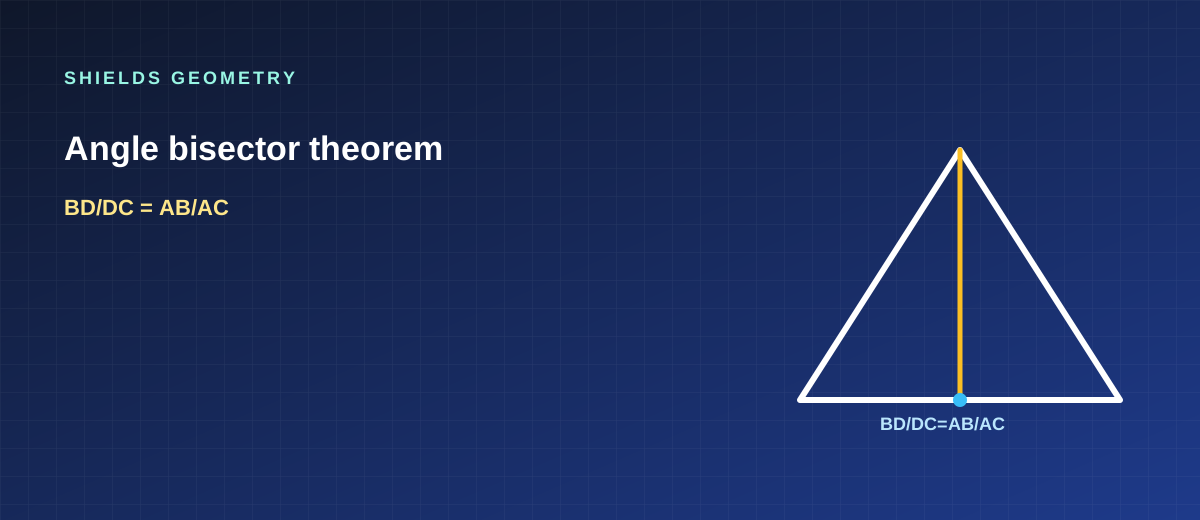
A bisector divides the opposite side in the ratio of the adjacent sides.
Key formulas

Statement
If AD bisects ∠A and meets BC at D, then BD/DC = AB/AC.
Example
AB=8, AC=6, BC=7. Then BD/DC=8/6=4/3. With BD+DC=7, BD=4, DC=3.
Proof idea
One standard proof uses area ratios or the law of sines in triangles ABD and ACD.
Worked example
Worked example
Problem. In △ABC, AB = 8, AC = 6, BC = 7. The bisector of ∠A meets BC at D. Find BD and DC.
Solution. BD/DC = AB/AC = 8/6 = 4/3. With BD + DC = 7: BD = 4, DC = 3.
Not altitude
The bisector is not generally perpendicular to BC.
Review quiz
AB=10, AC=15, BC=20. Bisector meets BC at D. BD equals:
Practice questions
- AB=10, AC=15, BC=20. Find BD and DC.
- State the converse of the angle bisector theorem.
Study notes
Internal only?
There is also an external bisector version with a minus sign in the ratio.
More in Plane Geometry
- Circle tangents: the radius is perpendicular
- Right-triangle lengths: Pythagoras and altitude
- Similar triangles: matching sides in proportion
- Chord theorem: perpendicular from the centre
- Isosceles triangles and equal base angles
- Alternate segment theorem with a short proof
- Converse of Pythagoras: proving a right angle
- Heron’s formula when height is hidden