Cone: from slant height to perpendicular height
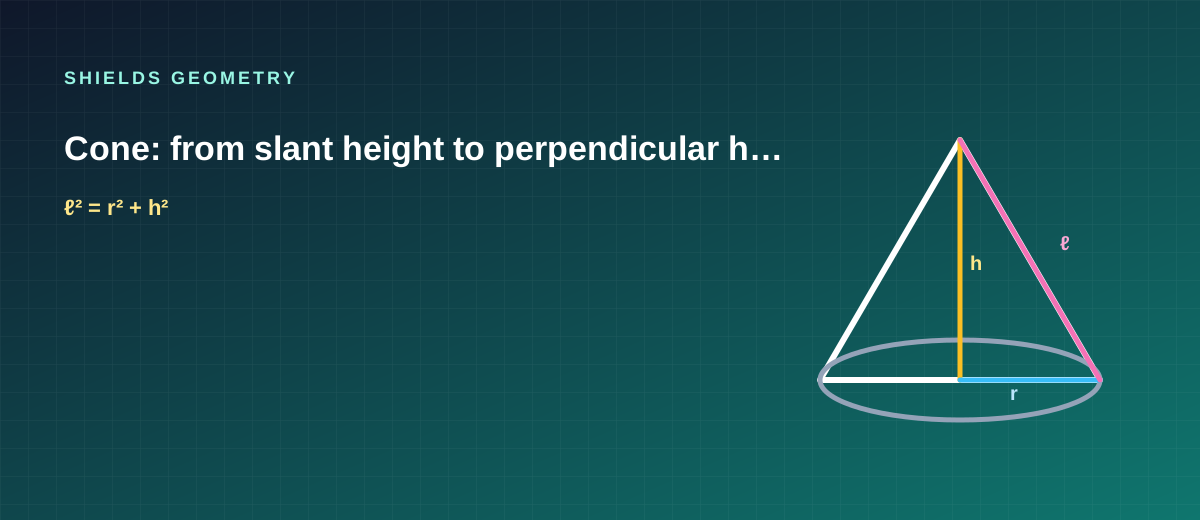
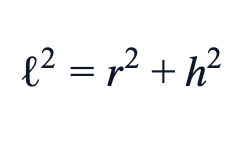
ℓ, r and h meet in a right triangle: ℓ² = r² + h².
Key formulas
Cut the cone
A vertical cross-section through the apex is an isosceles triangle. Half of it is right-angled with legs r, h and hypotenuse ℓ.
Example
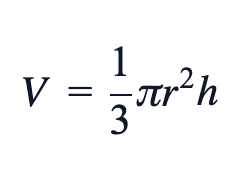
r=5, ℓ=13 → h=√(169−25)=12. Then V=(1/3)π(25)(12)=100π.
Surface note
Curved surface uses πrℓ, which needs the slant, not h. Volume needs h, not ℓ. Keep the roles separate.
Worked example
Worked example
Problem. A cone has r = 9 cm and slant height ℓ = 15 cm. Find h and the volume in terms of π.
Solution. h = √(15² − 9²) = √(225 − 81) = √144 = 12. V = (1/3)π × 81 × 12 = 324π cm³.
3-4-5
r=3, h=4, ℓ=5 is a classic quick check.
Review quiz
Cone r=8, ℓ=17. Height is:
Practice questions
- r=9, ℓ=15. Find h and V in terms of π.
- Why can ℓ never be shorter than r?
Study notes
Is slant height on the net?
Yes — the sector radius of the net equals ℓ.
More in Spatial Geometry
- Pyramid volume: identify the base and perpendicular height
- Distance from a point to a plane using volume
- Finding the angle between a line and a plane
- Writing the equation of a plane in 3D
- Cylinder volume and curved surface area
- Cone volume when slant height is given
- Prism volume from a cross-section
- Sphere volume without the fear of π