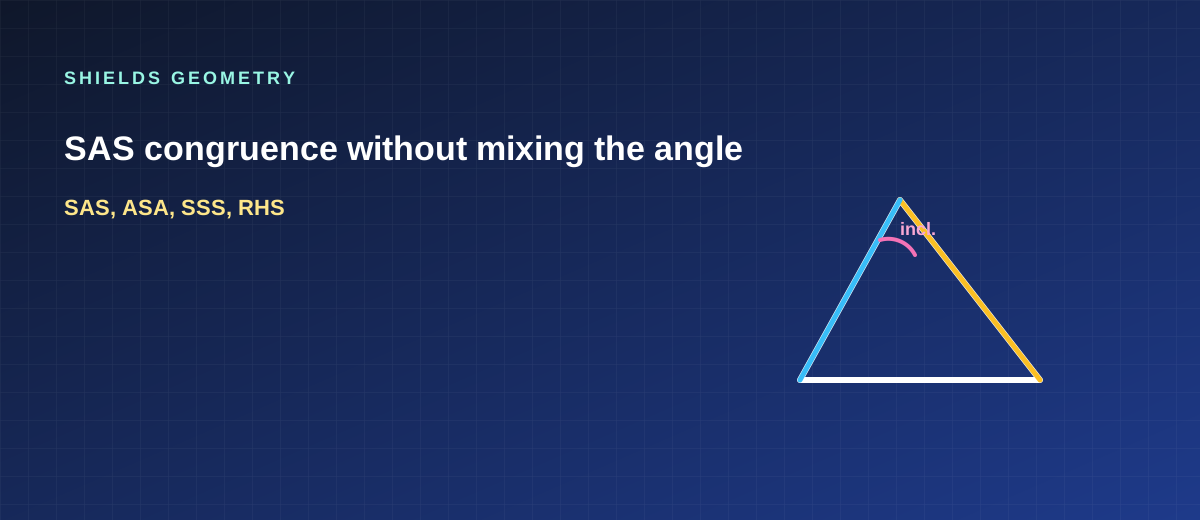
Two sides and the included angle — the angle must sit between those sides.
Key formulas

Included means between
If you know AB, AC and ∠B, that is not SAS. You need the angle at A between AB and AC.
RHS for right triangles
Right angle, hypotenuse and one other side give congruence — a special case worth memorising.
After congruence
Corresponding parts are equal. State which vertices match before transferring lengths.
Worked example
Worked example
Problem. In △ABC and △DEF, AB = DE = 6, AC = DF = 7, and ∠A = ∠D = 50°. Are the triangles congruent?
Solution. The equal angle is included between the two equal sides (SAS). Yes — △ABC ≅ △DEF by SAS.
SSA warning
Two sides and a non-included angle is not a congruence test in general.
Review quiz
Knowing AB=DE, AC=DF and ∠B=∠E (not at A) is generally:
Practice questions
- Explain why SSA fails with a counter-sketch.
- List the four standard congruence tests used in secondary geometry.
Study notes
Can SAS prove similarity only?
SAS with proportional sides is a similarity test; equal sides give congruence.
More in Plane Geometry
- Circle tangents: the radius is perpendicular
- Right-triangle lengths: Pythagoras and altitude
- Similar triangles: matching sides in proportion
- Chord theorem: perpendicular from the centre
- Isosceles triangles and equal base angles
- Alternate segment theorem with a short proof
- Converse of Pythagoras: proving a right angle
- Heron’s formula when height is hidden