Coordinate proof that a quadrilateral is a parallelogram
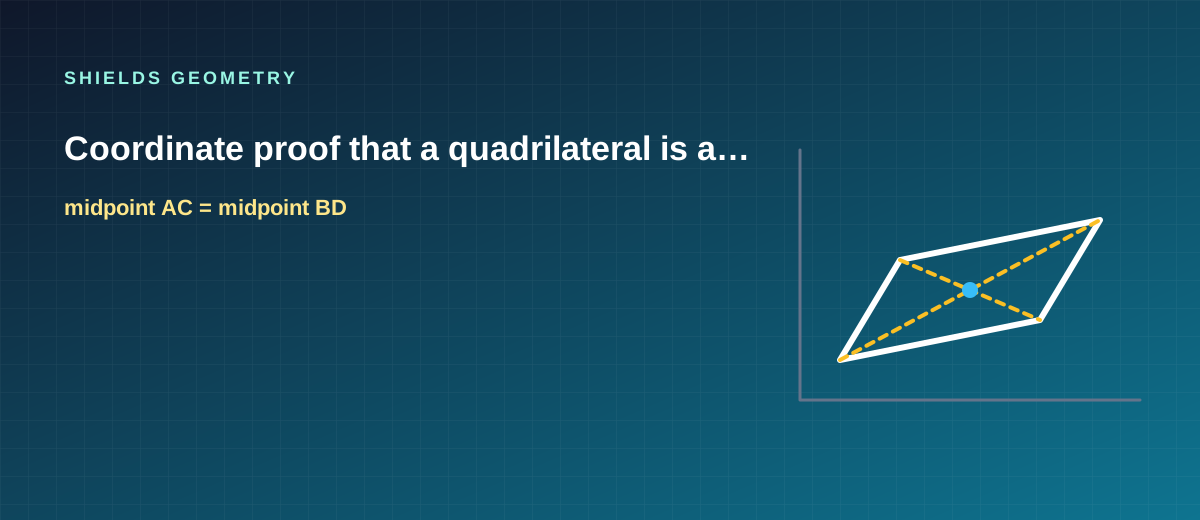
Show diagonals share a midpoint — or show both pairs of opposite sides are equal vectors.
Key formulas

Midpoint method
If diagonals bisect each other, the quadrilateral is a parallelogram. One midpoint calculation does the job.
Vector method
AB = DC and AD = BC as column vectors.
Example outline
A(0,0), B(5,1), C(7,4), D(2,3). Midpoint AC=(3.5,2), midpoint BD=(3.5,2). Done.
Worked example
Worked example
Problem. Show that A(0,0), B(5,1), C(7,4), D(2,3) form a parallelogram.
Solution. Midpoint of AC = (3.5, 2). Midpoint of BD = ((5+2)/2, (1+3)/2) = (3.5, 2). Diagonals bisect each other, so ABCD is a parallelogram.
Rectangle extra
Add equal diagonals or a right angle to upgrade the parallelogram.
Review quiz
A(8,8), B(14,10), C(17,16), D(11,14). Midpoint of AC is:
Practice questions
- A(1,1), B(6,2), C(7,5), D(2,4). Prove it is a parallelogram.
- Name two different sufficient conditions.
Study notes
Must I use distance?
Not for parallelogram — midpoint or vectors are enough.