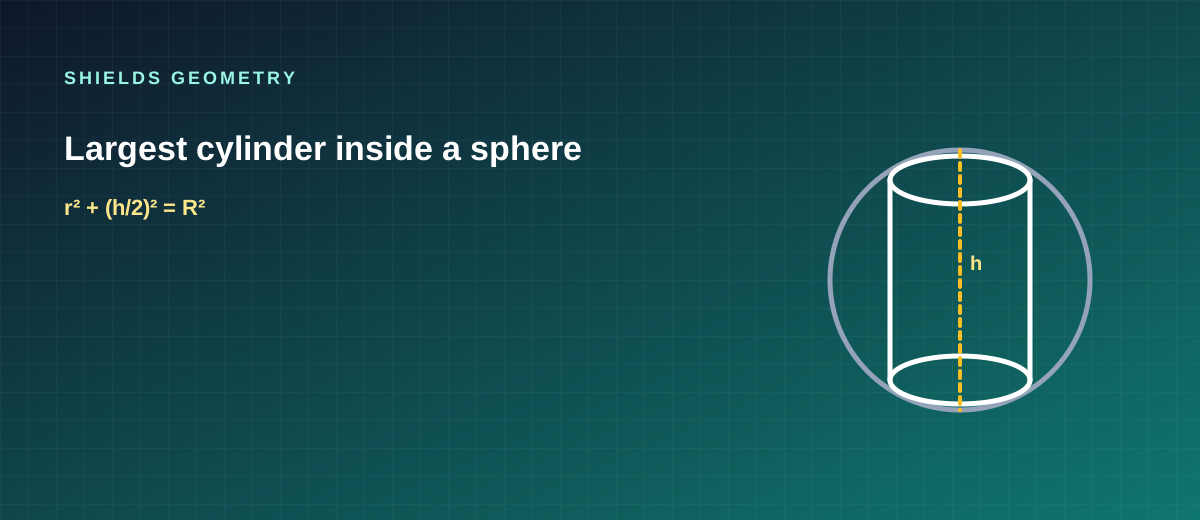
Relate cylinder radius and height to the sphere radius with a right triangle, then maximise volume.
Key formulas
Cut through the axis
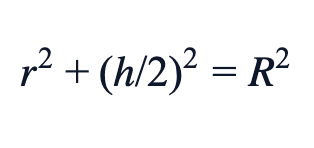
A vertical cross-section shows a rectangle inside a circle of radius R. Half the cylinder height and the cylinder radius form a right triangle with hypotenuse R.
Express V with one variable
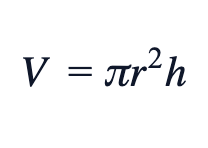
From r² = R² − (h/2)², V = π(R² − h²/4)h. Calculus or a completed-square argument finds the maximum.
Result to remember
The maximum occurs when h = (2R)/√3. You rarely need to re-derive it under time pressure if the question only asks for the relation.
Worked example
Worked example
Problem. A sphere of radius R = 6 has an inscribed cylinder of height h = 6. Find the cylinder radius.
Solution. r² + (h/2)² = R² → r² + 9 = 36 → r² = 27 → r = 3√3.
Constraint
Always start from r²+(h/2)²=R² before writing V.
Review quiz
Sphere R=5, cylinder height h=6. Cylinder radius r satisfies:
Practice questions
- If R=6 and h=6, find r.
- Why is h/2 used rather than h in the right triangle?
Study notes
Is the cylinder always upright?
This standard model assumes the cylinder axis through the sphere centre.
More in Spatial Geometry
- Pyramid volume: identify the base and perpendicular height
- Distance from a point to a plane using volume
- Finding the angle between a line and a plane
- Writing the equation of a plane in 3D
- Cylinder volume and curved surface area
- Cone volume when slant height is given
- Prism volume from a cross-section
- Sphere volume without the fear of π