Frustum of a pyramid: the cut-off top
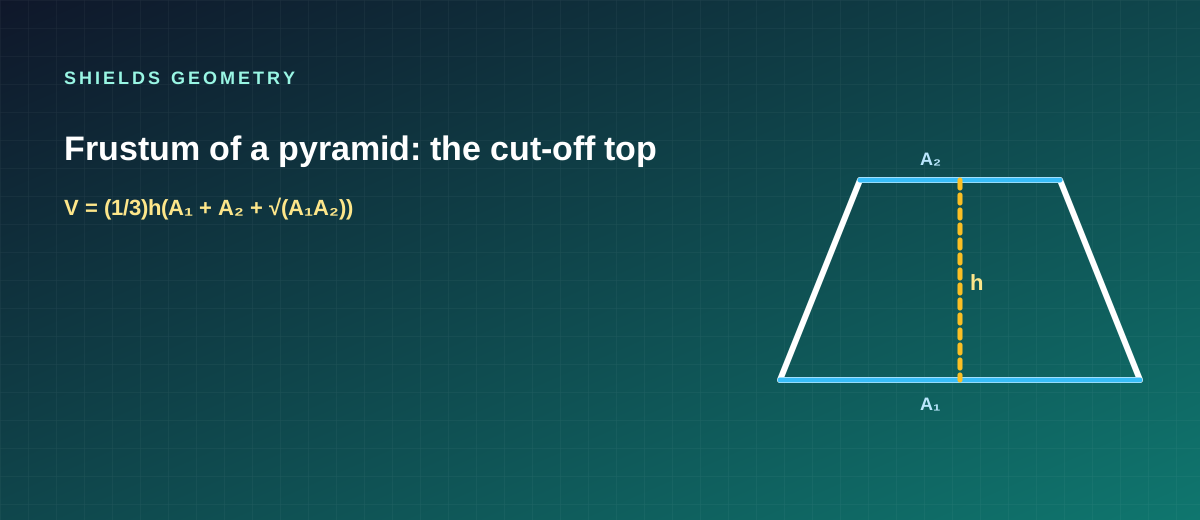
A frustum is what remains when a smaller similar pyramid is sliced off the top.
Key formulas
Picture first
You see two parallel bases with areas A₁ and A₂ and a perpendicular height h between them. The solid is neither a full pyramid nor a prism.
Plug in carefully
A₁ = 36, A₂ = 16, h = 9. Then √(A₁A₂)=24. V = (1/3)×9×(36+16+24)= (3)(76)=228.
Why the middle term?
The √(A₁A₂) term comes from comparing the large pyramid with the small one that was removed. Skipping it underestimates the volume.
Worked example
Worked example
Problem. A frustum has parallel face areas 36 cm² and 16 cm² and height 9 cm. Find its volume.
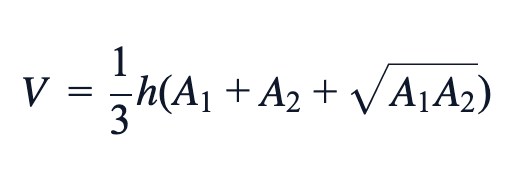
Solution. √(A₁A₂) = √(36 × 16) = 24. V = (1/3)h(A₁ + A₂ + √(A₁A₂)) = (1/3)×9×(36+16+24) = 3 × 76 = 228 cm³.
Sanity
If A₁=A₂, the formula becomes A×h, the prism case — a good check.
Review quiz
Frustum areas 25 and 9, height 6. Volume is:
Practice questions
- A₁=25, A₂=9, h=6. Find V.
- What happens in the formula when A₁ equals A₂?
Study notes
Do the bases have to be squares?
They must be similar shapes lying in parallel planes.
More in Spatial Geometry
- Pyramid volume: identify the base and perpendicular height
- Distance from a point to a plane using volume
- Finding the angle between a line and a plane
- Writing the equation of a plane in 3D
- Cylinder volume and curved surface area
- Cone volume when slant height is given
- Prism volume from a cross-section
- Sphere volume without the fear of π