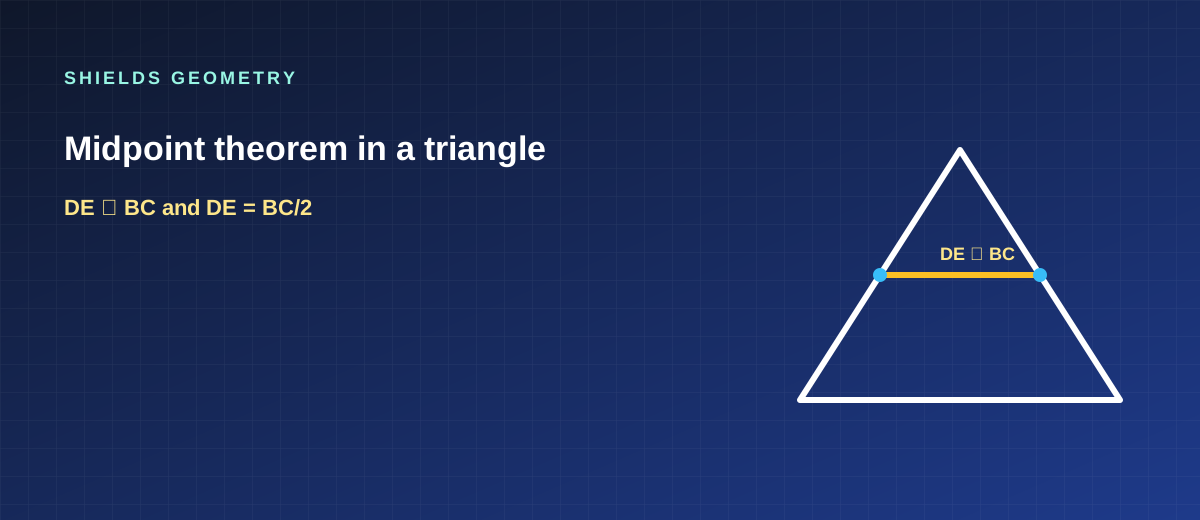
The segment joining midpoints of two sides is parallel to the third side and half as long.
Key formulas
Statement
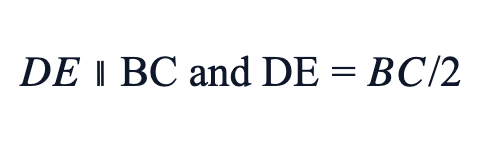
D, E midpoints of AB, AC → DE ∥ BC and DE = ½ BC.
Use in proofs
Often proves a smaller triangle similar to the original, or shows a parallelogram in a Varignon setting.
Numbers
BC=10 → DE=5. If BC has gradient m, DE has the same gradient.
Worked example
Worked example
Problem. In △ABC, D and E are midpoints of AB and AC. If BC = 18 cm, find DE.
Solution. By the midpoint theorem, DE ∥ BC and DE = BC/2 = 9 cm.
Converse
A line through the midpoint parallel to the third side bisects the other side.
Review quiz
BC=14, D and E midpoints of AB and AC. DE equals:
Practice questions
- AB=8, AC=10, BC=12. D,E midpoints. Find DE.
- State the converse of the midpoint theorem.
Study notes
Must the triangle be isosceles?
No — the theorem is general.
More in Plane Geometry
- Circle tangents: the radius is perpendicular
- Right-triangle lengths: Pythagoras and altitude
- Similar triangles: matching sides in proportion
- Chord theorem: perpendicular from the centre
- Isosceles triangles and equal base angles
- Alternate segment theorem with a short proof
- Converse of Pythagoras: proving a right angle
- Heron’s formula when height is hidden