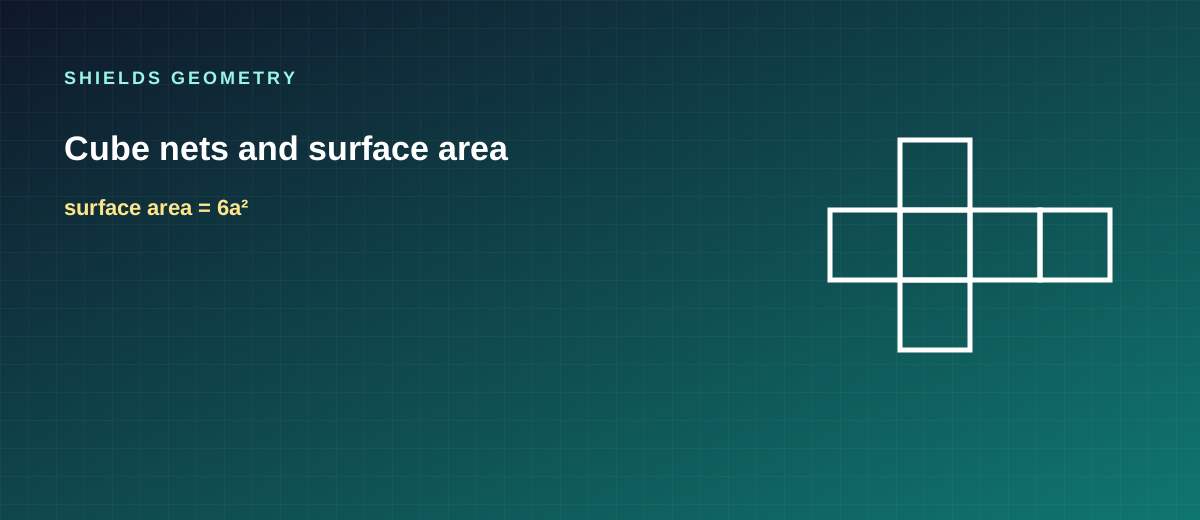
A cube has six square faces; any valid net must fold without overlap to make exactly those six faces.
Key formulas
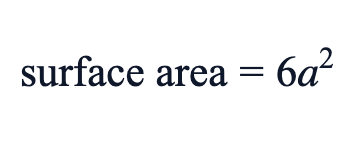
Area is easy
Edge a → each face a² → total 6a². The hard part in exams is recognising whether a drawn net can actually form a cube.
Invalid nets
A straight row of six squares folds into a tube, not a cube. More than four squares in a row also fails.
Example
a = 4 cm → surface area = 96 cm². Paint questions often ask how many faces get painted — that is surface thinking, not volume.
Worked example
Worked example
Problem. A cube has edge 5 cm. Find its total surface area.
Solution. Surface area = 6a² = 6 × 25 = 150 cm².
Painted cube
A 3×3×3 cube of unit cubes: only the outer faces are painted.
Review quiz
Cube edge 7 cm. Surface area is:
Practice questions
- Edge 9 cm. Find the surface area.
- Sketch one valid net and one invalid net of a cube.
Study notes
How many distinct cube nets are there?
Eleven hexomino nets fold into a cube.
More in Spatial Geometry
- Pyramid volume: identify the base and perpendicular height
- Distance from a point to a plane using volume
- Finding the angle between a line and a plane
- Writing the equation of a plane in 3D
- Cylinder volume and curved surface area
- Cone volume when slant height is given
- Prism volume from a cross-section
- Sphere volume without the fear of π