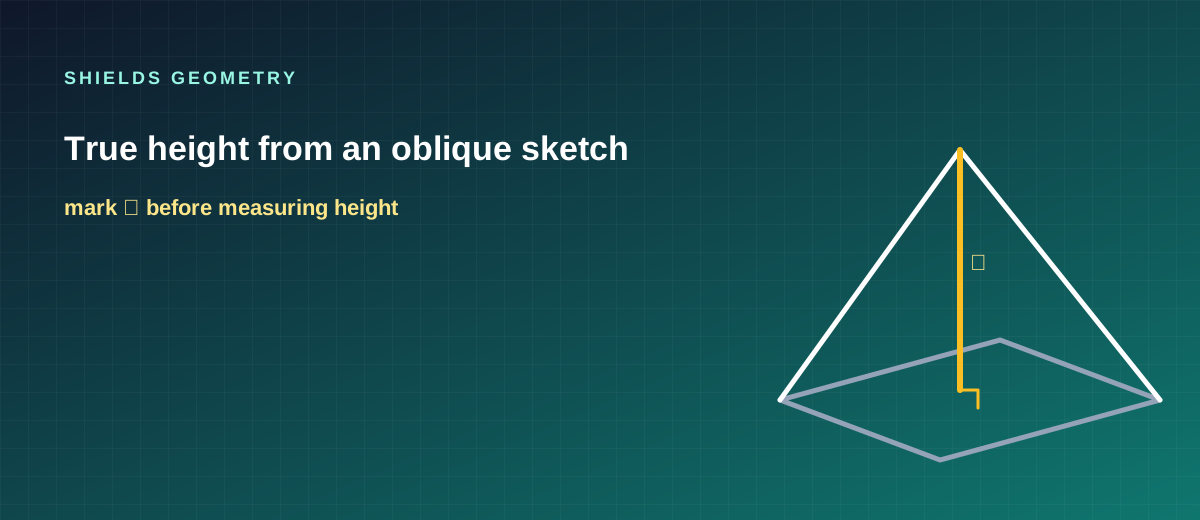
Sketches squash right angles. Trust the given relationships, not how vertical a line looks.
Key formulas
Drawings lie
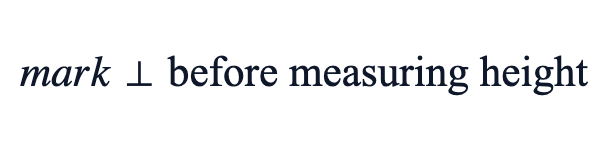
In an oblique drawing a perpendicular may look slanted. Mark the right angle yourself from the text: “AH is perpendicular to the base plane”.
Recovery method
Drop a perpendicular from the apex to the base, name the foot, then use Pythagoras in the right triangle formed with a base edge.
Classroom tip
Rewrite the givens as a list: edges, right angles, parallel pairs. Calculate only after the list is complete.
Worked example
Worked example
Problem. A pyramid looks slanted in a sketch, but the text says AH is perpendicular to the base and AH = 7 cm with base area 30 cm². Find the volume.
Solution. Ignore the slanted appearance. Use the stated perpendicular height: V = (1/3)×30×7 = 70 cm³.
Red flag
If two lengths look equal but are not marked equal, do not assume they are.
Review quiz
Given perpendicular height 10 cm and base area 24 cm², volume is:
Practice questions
- List three facts you must not assume from a sketch alone.
- Explain how to mark the foot of a perpendicular on a base.
Study notes
Why do textbooks use oblique drawings?
They show three faces at once, but they distort angles.
More in Spatial Geometry
- Pyramid volume: identify the base and perpendicular height
- Distance from a point to a plane using volume
- Finding the angle between a line and a plane
- Writing the equation of a plane in 3D
- Cylinder volume and curved surface area
- Cone volume when slant height is given
- Prism volume from a cross-section
- Sphere volume without the fear of π