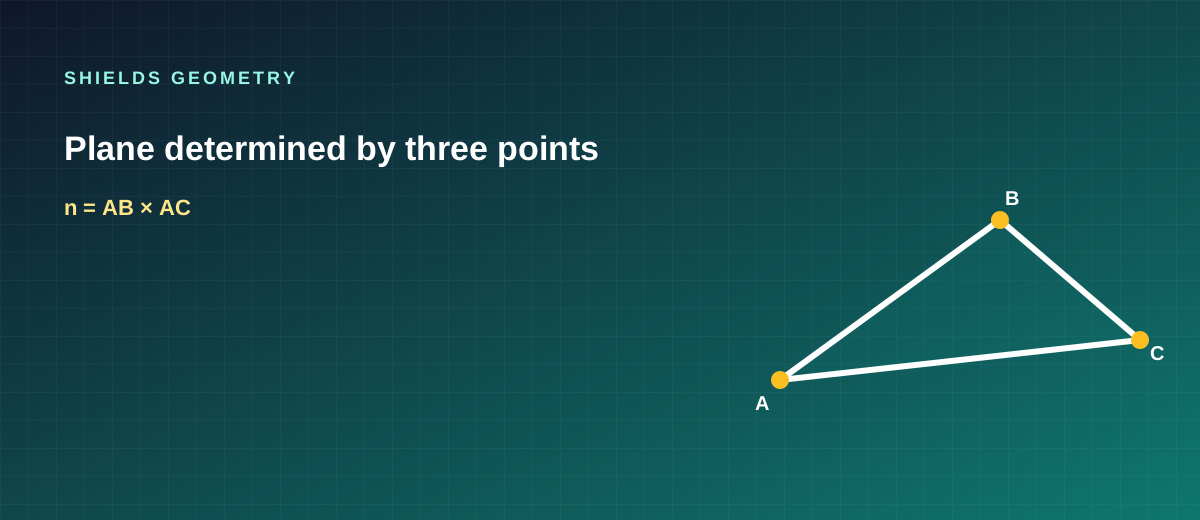
Three non-collinear points fix a plane: build two vectors, cross them for a normal, then write the equation.
Key formulas
Vectors in the plane
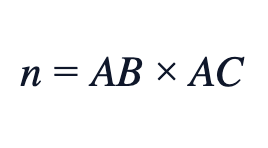
From A, B, C form AB and AC. Their cross product is perpendicular to every line in the plane.
Example outline
A(1,0,0), B(0,1,0), C(0,0,1). AB=(-1,1,0), AC=(-1,0,1). n = (1,1,1). Equation: x+y+z=1.
Collinear trap
If AB and AC are parallel, the cross product is zero and no unique plane exists — the points lie on a line.
Worked example
Worked example
Problem. Find the equation of the plane through A(1,0,0), B(0,1,0) and C(0,0,1).
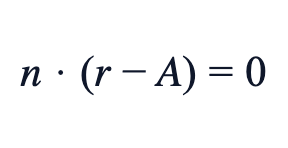
Solution. AB = (−1,1,0), AC = (−1,0,1). n = AB × AC = (1,1,1). Using A: 1(x−1)+1(y−0)+1(z−0)=0 → x + y + z = 1.
Check
Substitute A, B and C back into x+y+z=1.
Review quiz
Plane through (2,0,0), (0,2,0), (0,0,2) is:
Practice questions
- Points (2,0,0), (0,2,0), (0,0,2). Find the plane equation.
- How do you detect collinear points quickly?
Study notes
Can four points fail to be coplanar?
Yes. The fourth may not satisfy the plane of the first three.
More in Spatial Geometry
- Pyramid volume: identify the base and perpendicular height
- Distance from a point to a plane using volume
- Finding the angle between a line and a plane
- Writing the equation of a plane in 3D
- Cylinder volume and curved surface area
- Cone volume when slant height is given
- Prism volume from a cross-section
- Sphere volume without the fear of π