Surface area of a square-based pyramid
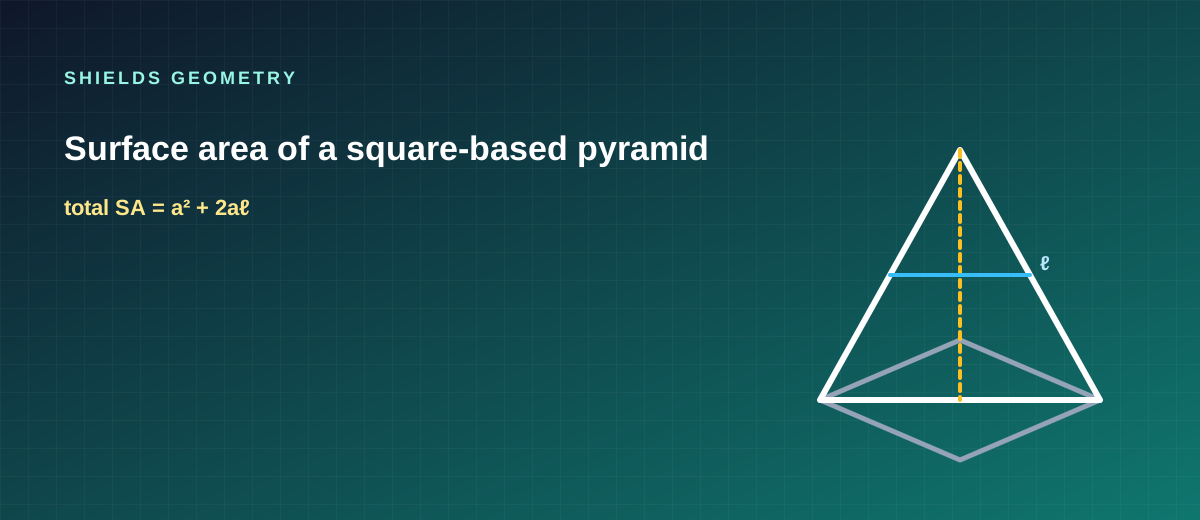
Add the base to four triangular faces — or use slant height for a quicker lateral total.
Key formulas
Pieces
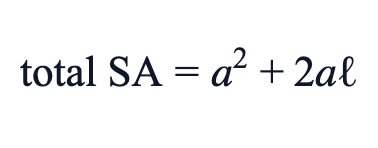
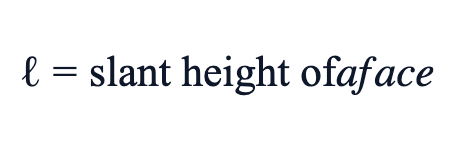
Base a². Each lateral face is a triangle with base a and slant height ℓ (the height of the triangular face, not the pyramid height). Four faces give 2aℓ.
Example
a=6, ℓ=5 → SA = 36 + 60 = 96.
Finding ℓ
If perpendicular height h is given, ℓ = √(h² + (a/2)²) for a square base.
Worked example
Worked example
Problem. A square-based pyramid has base side a = 6 cm and face slant height ℓ = 5 cm. Find the total surface area.
Solution. Base = 36. Lateral = 2aℓ = 2×6×5 = 60. Total SA = 36 + 60 = 96 cm².
Lateral only
Sometimes exams ask for lateral surface — omit a².
Review quiz
Square pyramid a=10, face slant height ℓ=8. Total SA is:
Practice questions
- a=10, ℓ=8. Find total SA.
- a=8, h=3. Find ℓ then lateral SA.
Study notes
Slant height vs lateral edge?
Slant height meets the midpoint of a base edge; a lateral edge goes to a base vertex.
More in Spatial Geometry
- Pyramid volume: identify the base and perpendicular height
- Distance from a point to a plane using volume
- Finding the angle between a line and a plane
- Writing the equation of a plane in 3D
- Cylinder volume and curved surface area
- Cone volume when slant height is given
- Prism volume from a cross-section
- Sphere volume without the fear of π