Shortest distance between skew lines
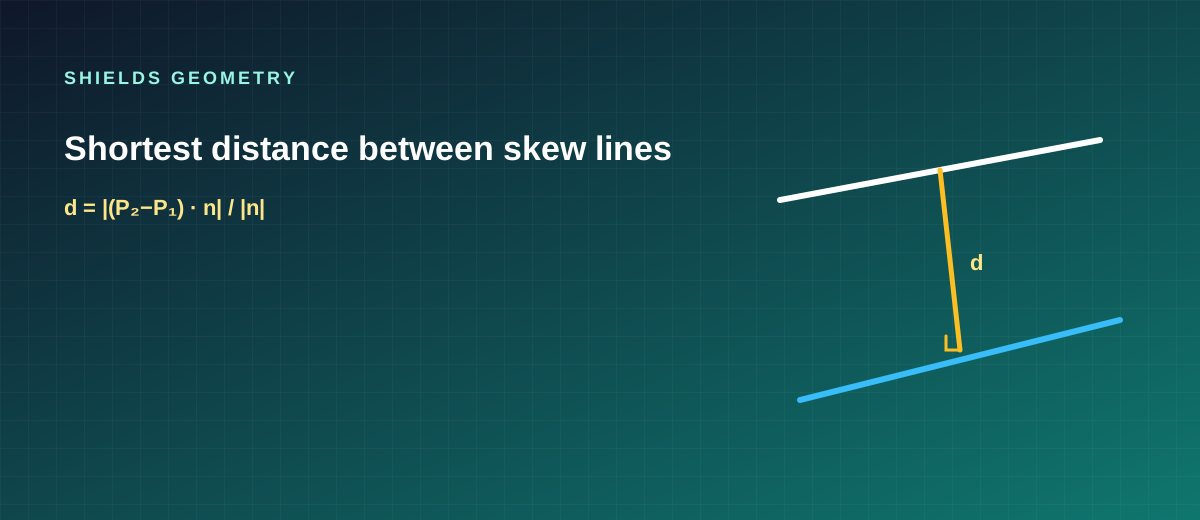
Skew lines never meet and are not parallel; the shortest gap is along their common perpendicular.
Key formulas
What skew means
In 3D, two lines can fail to intersect without being parallel. The common perpendicular is unique and gives the minimum distance.
Vector formula
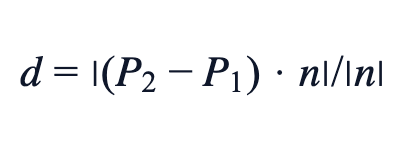
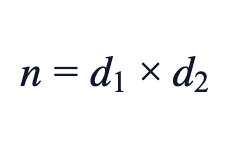
Direction vectors d₁, d₂ give n = d₁ × d₂. Take any points P₁, P₂ on the lines. Then d = |(P₂−P₁)·n| / |n|.
If they are parallel
Then d₁ × d₂ = 0. Use a different method: distance from a point on one line to the other line.
Worked example
Worked example
Problem. Line 1 passes through (0,0,0) with direction (1,0,0). Line 2 passes through (0,0,5) with direction (0,1,0). Find the shortest distance between them.
Solution. d₁ × d₂ = (0,0,1), |n| = 1. (P₂ − P₁) · n = (0,0,5)·(0,0,1) = 5. Distance = 5/1 = 5. The lines are skew (or parallel in xy sense) with gap 5 along z.
Flag
If n = 0, stop — the lines are parallel, not skew.
Review quiz
Lines through (3,4,6) with direction (2,0,0) and through (3,4,13) with direction (0,2,0). Shortest distance is:
Practice questions
- Explain why skew lines cannot lie in one plane.
- Write the distance formula in words before symbols.
Study notes
Do skew lines exist in 2D?
No. In a plane, non-parallel lines always meet.
More in Spatial Geometry
- Pyramid volume: identify the base and perpendicular height
- Distance from a point to a plane using volume
- Finding the angle between a line and a plane
- Writing the equation of a plane in 3D
- Cylinder volume and curved surface area
- Cone volume when slant height is given
- Prism volume from a cross-section
- Sphere volume without the fear of π