Shortest path via a mirror line
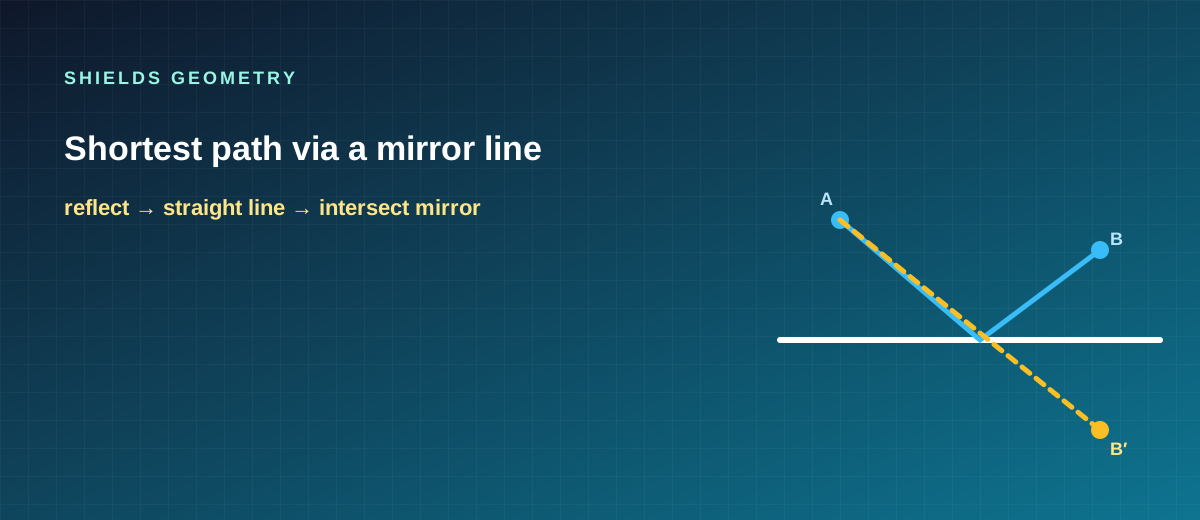
To bounce off a line, reflect one endpoint and connect with a straight segment.
Key formulas

Why reflection works
Any path that hits the mirror has the same length as a path to the reflected point. The straight line is shortest, so its intersection is optimal.
Example
From A to line L to B: reflect B to B′, draw AB′, mark the hit point P. Then AP+PB is minimal.
Billiards and light
Angle of incidence equals angle of reflection — automatic from this construction.
Worked example
Worked example
Problem. Point A is (1, 3) and B is (5, 2). Find the point P on the x-axis that minimises AP + PB.
Solution. Reflect B in the x-axis to B′(5, −2). Straight line AB′: from (1,3) to (5,−2) has slope (−2−3)/(5−1) = −5/4. Equation: y − 3 = (−5/4)(x − 1). Hits x-axis when y = 0: −3 = (−5/4)(x−1) → 12/5 = x − 1 → x = 17/5. So P = (17/5, 0).
Same side
If A and B are on the same side, still reflect one; the geometry is unchanged.
Review quiz
Minimising path to the x-axis then to B, you reflect B across:
Practice questions
- Describe the steps to minimise A→x-axis→B.
- Why is a bent path longer than AB′?
Study notes
Coordinate formula?
Reflecting in y=0 sends (x,y) to (x,−y).