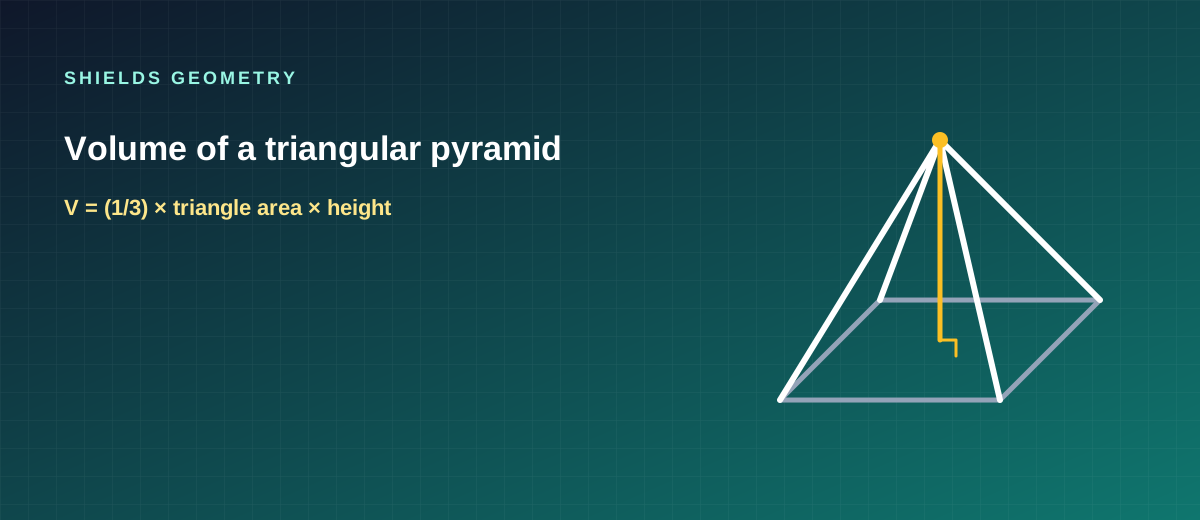
A tetrahedron is a triangular pyramid: still one third of base area times height.
Key formulas
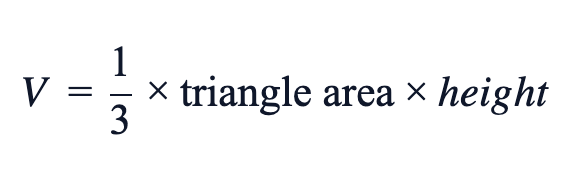
Name the base
Choose one triangular face as the base. Find its area with ½bh or Heron if needed. The height is the perpendicular from the opposite vertex to that face.
Calculation
Base area 18 cm², height 7 cm → V = (1/3)×18×7 = 42 cm³.
Common confusion
Students sometimes use the area of a different face with the wrong height. The height must match the base you chose.
Worked example
Worked example
Problem. A triangular pyramid has base area 21 cm² and perpendicular height 8 cm. Find its volume.
Solution. V = (1/3) × 21 × 8 = 56 cm³.
Match them
If you switch base, you must also switch to the corresponding height; V stays the same.
Review quiz
Base area 30 cm², height 6 cm. Pyramid volume is:
Practice questions
- Base area 24 cm², height 5 cm. Find V.
- Explain why changing the base does not change the volume.
Study notes
Is every tetrahedron regular?
No. Regular means all edges equal; the volume formula still works for irregular ones.
More in Spatial Geometry
- Pyramid volume: identify the base and perpendicular height
- Distance from a point to a plane using volume
- Finding the angle between a line and a plane
- Writing the equation of a plane in 3D
- Cylinder volume and curved surface area
- Cone volume when slant height is given
- Prism volume from a cross-section
- Sphere volume without the fear of π