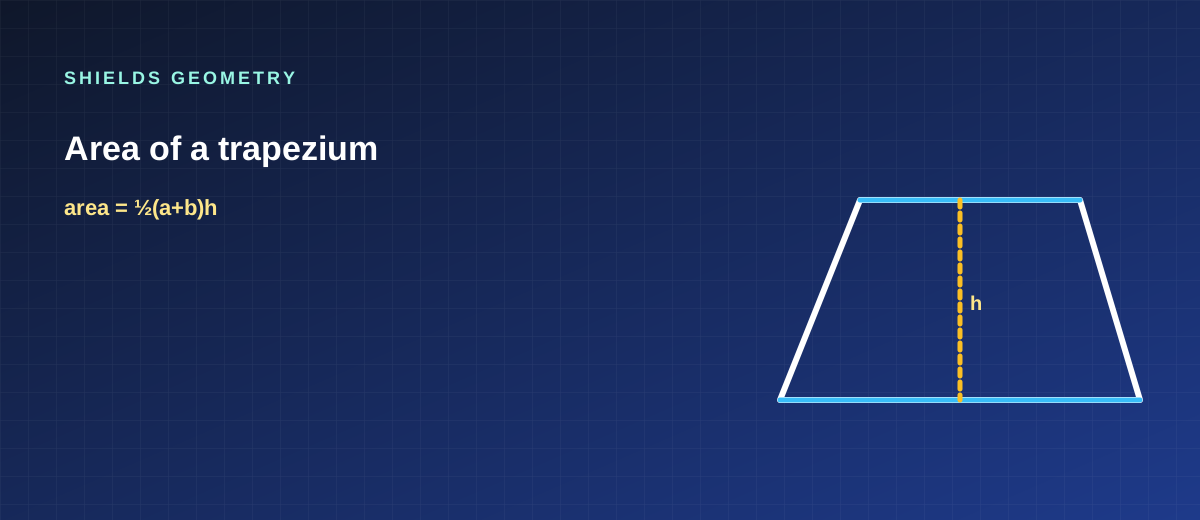
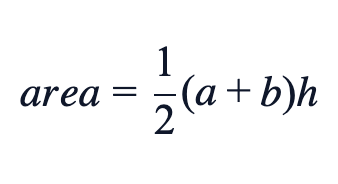
Average the parallel sides, then multiply by the height.
Key formulas
Identify parallels
Only the parallel pair a and b enter the average. The non-parallel sides (legs) are not averaged.
Example
Parallel sides 7 and 13, height 5 → area = ½(20)×5 = 50.
Drop perpendiculars
If height is missing, drop perpendiculars from the ends of the shorter base to split a rectangle and right triangles.
Worked example
Worked example
Problem. A trapezium has parallel sides 7 cm and 13 cm and height 5 cm. Find its area.
Solution. Area = ½(a+b)h = ½(7+13)×5 = 50 cm².
Units
Height must be perpendicular distance between the parallel sides.
Review quiz
Parallels 9 and 15, height 4. Area is:
Practice questions
- a=9, b=15, h=4. Find area.
- A trapezium has parallels 8 and 12 and area 50. Find h.
Study notes
Isosceles trapezium?
Legs equal and base angles equal; area formula unchanged.
More in Plane Geometry
- Circle tangents: the radius is perpendicular
- Right-triangle lengths: Pythagoras and altitude
- Similar triangles: matching sides in proportion
- Chord theorem: perpendicular from the centre
- Isosceles triangles and equal base angles
- Alternate segment theorem with a short proof
- Converse of Pythagoras: proving a right angle
- Heron’s formula when height is hidden